

Central Texas storm effects (Pic heavy)
I have been working on land restoration for a few years. We have just had some atrocious rains in the neighborhood. I was under the gun of 3 tornados that were said to be headed to me or once reported mistakenly, ON me. I dodged this bullet. What I did find interesting is the difference in how my land is acting in and after the deluge. I have been clearing underbrush on a steep ravine for years , mostly during an ongoing drought. I create berms with the slash parallel to imaginary topographic lines. I have left some branches in the stream bed since I am in a catch and drop area of the uplands. I might , most likely , do not have the proper terminology that I heard at a riparian workshop. I am well meaning dilettante who tries to self educate and I do misconstrue terms right and left. Sorry about that . My husband has been set against this messy slash activity, because it just isn't tidy. He wants a park with effortless walking. If the lay of the land is steep or if there are some wanted trees that I want more of. I pile the slash deep to keep the deer from foraging the madness, escarpment cherries, redwoods, bumela and others. I have discovered that nature rewards a mess and the bigger the mess the better. I think my husband is coming around being how the land is reacting to this treatment. I am also trying to hold the water back and slow it down.
Well the usually DRY arroyo rose up in all its glory and showed why there was such erosion on the land. The first picture is of the top fall the morning after the first two storms. I was amazed that we had any water running 20 hours after the deluge. Usually in, in the past we had it ONLY during the storm. It was still running gently. I was in my orange nighty and grabbed my camera and went off bushwacking. That's when I lost my sun glasses.
My neighbor is the tallest place in the county so my land does not drain much. But there is a ravine in the back that goes from negligible to 100' deep pretty darn quickly, and continues to deepen on my neighbors lands. On the second day I ran out as soon as the storm past with camera, this time in ranger and umbrela. I wanted to document the draining in relation to the left behind slash. Kind of a pictorial "I told you so , honey". Also I need it for the documentation.
Day one
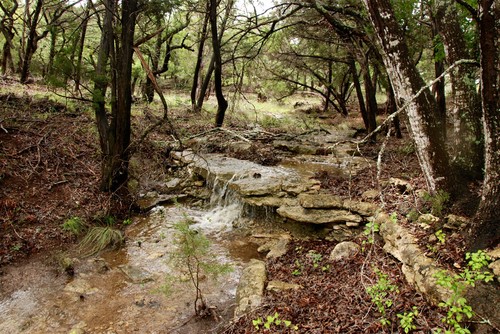
right after the second day of storms
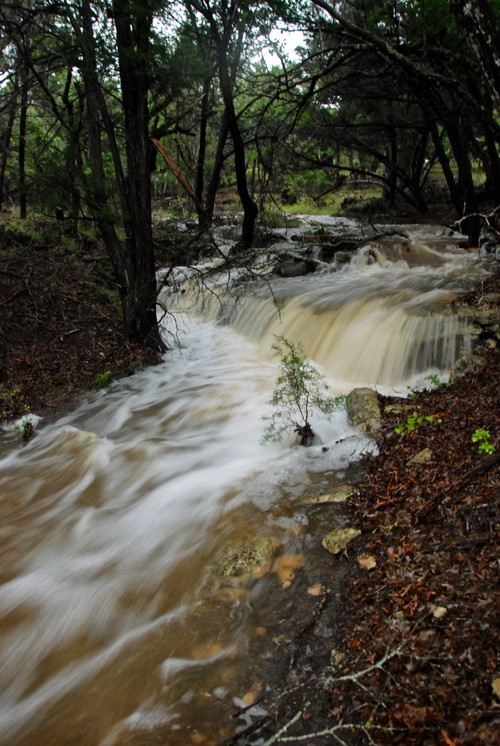
Running through the valley
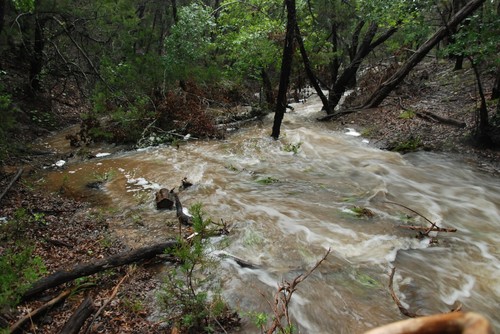
spilling out from the upper flatter valley area
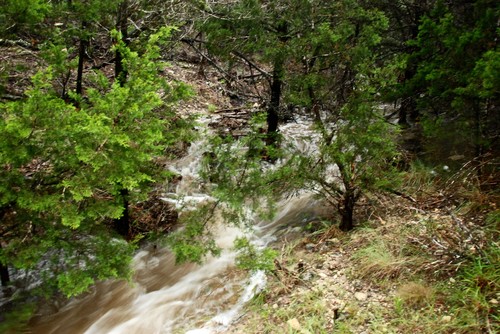
into a tank that sits astride where the valley just drops away
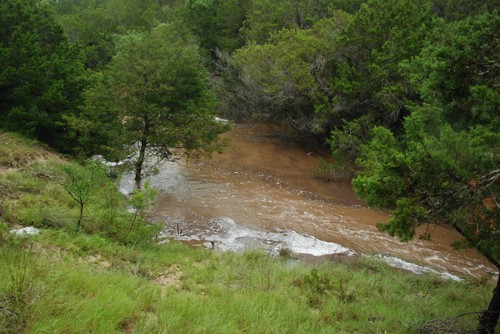
One of several falls that were cresting the levy
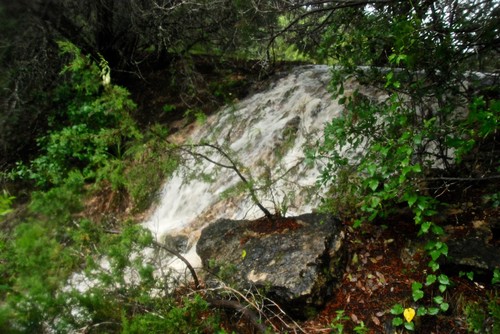
Looking down
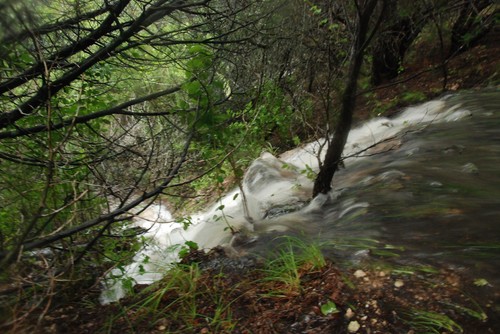
A falls of lower down. Bigger, louder. I could not get closer . I am looking down about 20'. I have already shinnied down and climbed out on some slippery cedar branches. I ain't going any further. The valley was a rocking and a roiling.
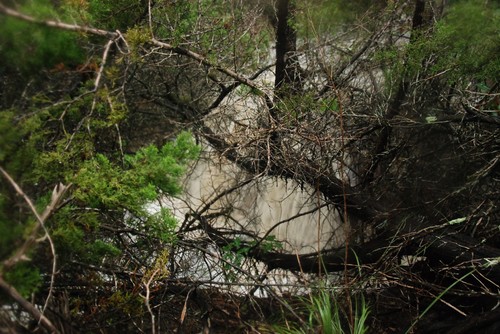
I did slip down on my ass and holding onto cedar trunks into the ravine and got this very awkward shot
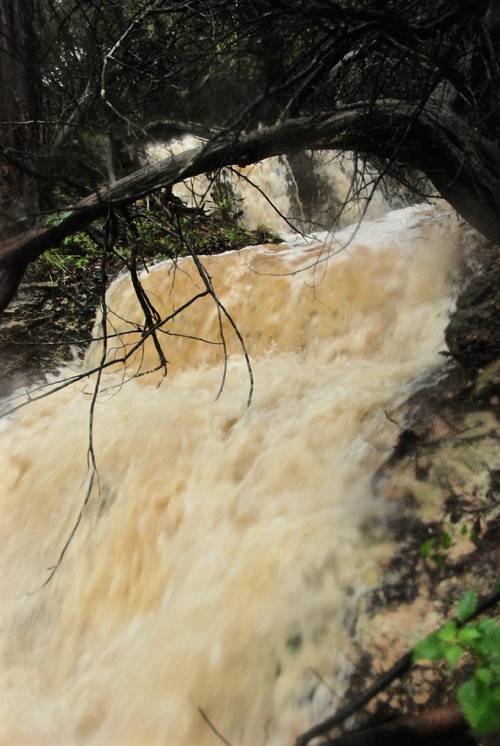
A couple hours later a cut in the levee had drained the tank down a foot or so and it was now just what was draining out of the cut and minus three other smaller falls. This is one of my more favorite places on my land but it is difficult to get to.
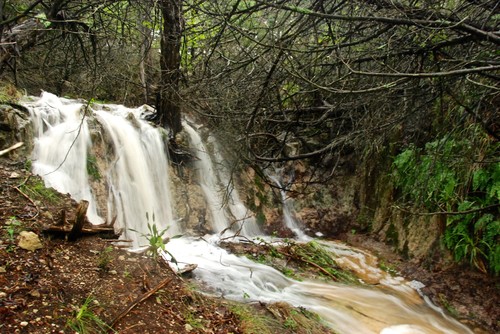
It is hard to see that things I did have slowed the water down, but it has because the land is still draining and streams still flowing and flowing CLEAR. All that mess acts to strain the water of caliche and some of the mud. Not all of it but a lot of it when it is raging. Now it is very clear. It never flowed clear before. This makes me feel that I have done well in this wild and wooly environment of extremes.
*****It is hard to celebrate when others have suffered so from this storm.







Those were the drama shots. I am always a lover of drama. Here are some of the more boring shots about what I did and how they are slowing things down with the berms and slash at 90 degrees to the grade. I also just left a bunch of stuff in the stream. Most of that got washed out in the second storm.
Day 1
Standing water behind a a dam showing tannic acid staining from the oak leaves.
Day two : this section got all washed away. OH well. I need to re think this. Notice the standing wave. I learned about that in the riparian workshop. It was interesting to see it in real life.
Berms slowing water and so much more native sedge growing in the opened up woodlands. That does a great job at straining and slowing the run off. This section was worked on 2 or3 years ago.
This is looking up a pretty steep slope where I left a lot of slash hanging and it is where I am finding a whole bunch of seedlings that I have mentioned in other threads.
Looking down the same slope. One can see the water in the lower tank way down below. One can see the water pooling in the slash.
Here is an area that is a bowl and I left slash at 90 degrees and made berms. This was done this winter so it is still in Bad haircut blues. But you can see the sedges taking root and making themselves evident. The erosion was particularly bad here, The erosion swept away any leaf duff quickly and there was no decomposition. It was swept down into the stream.
More .. This is already catching leaf litter and duff. Logs are on their way to being buried. I planted some seeds of grass in this area. I am hoping for blast off. I still need to do some more clean up. I was moving very quickly when I was working here.
Here is a picture of some of the slopes that I am working with. The brush just gets washed away down slope. I did get some Kansa Liatris mucronada or L. punctata to take right above there. I can't wait the several years for it to bloom.
This is a pathway that is normally 10- 12' off the floor of the tank. It is so weird for me to see it like this. Normally I am working clearing and I am high up here. That is a Nolina lindheimeri that normally drapes gracefully far over a high ledge. SOMEONE, remind me to check my lens for water. It was still very wet. Everything was dripping. It ruins a good shot unless I can BS my way and say I was using a special filter.
I walked to the front of the land where I was much more sparing in the amount of brush used in the slash retention on the lower slope of the hill in the background and , guess what, the water was no were to be seen except in the front Tank. No puddling in the woods and on the slopes.. There are gullies that cut across the land directing flow to this 15' deep hole in the ground. Unfortunately this is a real leaky tank. The water will be gone in a day or two but it is headed for the Aquifer, and all the water flowing out of the back tank theoretically will be drank by the hipsters in Austin.
Here is the rare saprophytic orchid, Hexalectris nitida or a Hexalectris spicata var arizonicas that I found while looking for my lost glasses. I did find my glasses after the 4th time retracing my steps. They grow off of some microbial presence in the soil. I am trying to get a photo of this one every other day .
Amazing pictures, amazing work! It's like horticulture, ecology, and geological engineering wrapped into one. It looks like you're slowing down erosion, slowing down the water flow, and capturing more water in the soil, where it filters out pollutants. And you're nourishing more vegetation and wildlife. And you're doing it naturally, without concrete berms or pipes. This is more of how urban areas should handle irrigation and flood control. Engineers have spent centuries building all these gutters and ditches that whisk water away from buildings, dump it in sewer systems, and along the way collect pesticides, herbicides, fertilizers, gasoline droplets from cars and lawnmowers, plastic debris, and all kinds of other nasty junk that pollutes our water supply. Nature can do such a great job of filtering our water for us. We don't need more multi-million-dollar water filtration plants. We need more natural landscapes to capture water in our soil and vegetation.
Mara, when you say tank, do you refer to a natural depression or is it something you've created? I love your pictures and storytelling. And that is one beautiful orchid!
I can't tell you how much you've influenced my thinking and methods of gardening.
Be careful out there, it's dangerous.
Thank you for posting these, and for all of your hard work in putting that together in your property - you are amazing. And please, as PKponder says, be careful!
Yeah, you don't want to go to Heaven any time soon. I hear the only natives that grow in those clouds are epiphytes. And while you can probably do a little container gardening in urns, allegedly all they have there are Lily-of-the-Valley, Gardenia, and Jasmine. So stay clear of those rocky precipices in the Hill Country. And the mosquito bogs in Houston.
Loreleicomal, Tanks as in the fake ponds for cattle originally. depressions or levies holding back water. They were on the land when I got it. So were the feeder channels. I only noticed them and realized their function several years after I moved here.
As for me risking life and limb. I LOVE TO. I am a 61 year old monkey, rock climber, pick axe and chain saw wielding woman. I am careful but I do and always will take risks. I have some rules , like if it is wet enough to wear a raincoat , then one should not be carrying a chainsaw. I broke some fingers learning that rule. Cameras are OK to take into wet trees on cliffs while wearing raincoats. I move slowly . Incremental damage will make the lesson unforgettable. But thank you all for being concerned about my well being, I will take it to heart but I am still going to risk life and limb but I promise to be careful.
***** I think of dead branches of cedar as slowly forming the bones of the soil. They really do hold things back. I also see large garter snakes and lizards skirting through the berms. I am always trying to think of different ways to use the slash. Wildlife loves t it and I can use it to protect young seedlings and create structures for vines. I use to burn it but now I see the slash as holding a goodly portion of the nutrient load of the forest and if you burn it, you are taking that out of circulation.
Wow Mara! I'm impressed. I remember you talking about how you're working with your land. It's great that you got the rain to see how the berms, etc. functioned. Makes me think of what the Bamberger Ranch. is doing. Thanks for all the fantastic, exciting photos.
I took a workshop at Bamberger's Ranch YEARS ago when I first started out here. I realized pretty quickly that I was damaging the land when we worked on it. There were different rules out here than in my little lot downtown. I started taking lots of workshops. i would like to do the master naturalist program and the fire burning school. Now THERE'S a risk. I have done some small burns and need to learn about the legalities and processes. I have a text book for it.
Wow mara, those are great shots. Made me nervous when you said you climbed on slippery branches. Do be careful. Your land is gorgeous and it's inspiring to see what you are doing with it. How much land do you have there?
I have 17 acres. I work about 1.5 acres a year clearing underbrush protecting trees, monitoring birds.
My ID on the orchid is not firm. I IDed it only seeing the seeds. I might be H. spicata var arizonica. I just read this tonight. It describes so many of the plants here and the observations about the cedar mulch is just what I experience.
http://www.biosci.utexas.edu/prc/digflora/juas/JUAS-assoc.html
Thanks for the photos, actually a tutorial for me.
Molly
Enjoyed the whole thread, thanks!
Here are some more shots of the berms. and one area that drains a large bowl..It has been stripped of anything healthy here forever.
Berms, swales, whatever you want to call them stretching in rows up the hill
Here is a BEFORE picture showing the erosion blighted area.
And I have left it an incredible mess that will look like hell for 5 years or more. Soil building is a long process. It is already getting crushed down and the logs are almost half buried with silt.
Thanks for the additional photos. Beautiful and inspiring, but sure looks like a lot of work for one woman. More power to you!
These last photos were a great tutorial for me on erosion, overgrazing, and desertification. Looking at these, I think I now know what they mean when they say that the Big Bend region is plagued by overgrazing. A lot of the former ranch land out there looks a lot like your 3rd picture: a landscape of mostly sand, punctuated by lonely trees jutting out. I figured it was caused by drought or wildfire or was just the natural look of the land. But it's none of those things. It should be either be a lush prairie or a healthy-looking woods - more like your other pictures. The ground should never look like sand. Not unless you're on a beach or in the Sahara Desert. This also explains why beaches look this way. The waves continually strip all vegetation and nutrients away. And that's why coastlines are always eroding and moving. There's nothing to anchor them. Ecologically-speaking, a sandy landscape is a dead one. If you see sandy ground, you're looking at ground that was ecologically destroyed.
I think it's amazing that you're bringing it back. All it needs is a number of years of decomposing leaf litter to stay in place and the worms and bugs and microorganisms will return and revert into living soil once again.
Much of my yard was badly-eroded, unmulched and swept clean leaf litter for many, many years by previous owners. It looked "clean" to them. That's how most folks in my neighborhood still keep much of their yards. Bare dirt. The wind blows some of it away. Every time it rains, more of it washes away. It gets drier and drier and lower and lower in a downward spiral. My yard must have gone down at least 6 inches in depth over the years.
Then I started to let leaf litter accumulate on the ground year-round. Now I'm the oddball freak of my neighborhood. But things actually grow in that area now. It's only 2 or 3 years later. Before that, nothing would grow. Not even weeds. It was almost as bad as the land in your 3rd picture. But now the soil level has raised maybe an inch. I find earthworms and bugs in it now. It's slowly coming back to life.
The before and after pictures are really educational Mara. Thanks for showing them.
I have to keep reminding myself that her area is supposed to look like grassy meadows with sparse trees, kind of like a wild golf course, park-like and shady along the creeks. That explains why she does controlled burning and cutting down shrubs with a chainsaw. It looks like she has native grasslands re-established in some places. I'm guessing she's scattering Buffalo Grass seed by the truckload? :) The former ranchers must have let their cattle graze those original grasslands into desert. It's sad that they were so destructive to their own livelihoods from being so clueless. It's great to see her bringing the land back. The droughts, invasive species, and messed-up cowboy irrigation have got to be frustrating!
NO, much of my land looks like rocky hill country and will always look like rocky hill country , but some of it is grassy. I live on Marl. (Marl is the name of my inner Be-yatch.) This area probably had some grass cover. I would like to get some short grass prairie on the upper part and some sedges under the trees. I gave up on what it is supposed to look like. I look only for what I have a chance to do with it. I have scattered seed in a spotty manner. . I might this fall.I scattered a couple of bags that were sent to me here in this area, here and there but I am depending on what is in the seed bank of the land. I scattered bluestem, side oats game , purple tree awn amongst the branches and slash. I hope they germinate in all this rain. For once the weather is cooperating. I am hoping for results. What you don't see is the seedlings of aggravate, evergreen smack , bumela. I did also seed out a bunch of liatris, ipomopsis, wine cups, calylophus, Broom snakeweed, and Ageratina havanense. I want to develop more under brush, I just want it to be diverse. I see the beginning of it.On the steep slopes, I will leave the cedar . On the rocky stuff, I leave a lot of the cedar. It is a good ground builder.