

Return to the Edible Landscape Forum
| Post a Follow-Up
Question about the American Elderberry
| | |
Posted by paulan70 5 (My Page) on Sat, Apr 29, 06 at 5:07
| We recently added an american elderberry to our garden. Now here is my question what type of fertilzier does it need? And how often. And also will the American Elderberry produce berries on it's own or does it need another elderberry to produce berries and what type would be best for the American elderberry. Thanks so much
Paula |
Follow-Up Postings:
RE: Question about the American Elderberry
| | |
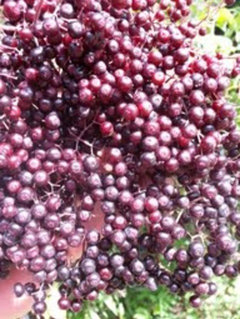
| The American Elderberry (Sambucus canadensis) probably doesn't need much fertilizer in most situations, but it is hard to say in your situation, since you don't list your location in your member page and don't tell us what your soil is like. I would guess that you could fertilize it with whatever works for other flowering plants in your yard, without too much nitrogen, which could induce rank growth. It is a suckering plant and quite fast-growing to about 12 ft high and 12 ft wide. You may want to figure out if you will need to limit growth. It grows near riverbanks in the wild and likes lots of water. It can take light shade. It attracts birds. If you are growing it for fruit, you should plant another S. canadensis variety with it. You can place it quite close to your first plant and let them grow together if you like. If you planted a seedling, you can plant another seedling (but not a sucker from the same plant) for pollenization. Varieties known for good fruit include Johns, Adams and Nova. One Green World sells Johns and Nova. Ornamental varieties include Aurea, Lacinata and Maxima. They would probably also work for pollination and would likely give you some fruit, too (though not of the quality of the types developed for fruit). Be aware that there are other elderberries besides the American Elderberry which are native to the Americas. The kinds with red fruit must be cooked before eating. |
Here is a link that might be useful: One Green World Elderberries
RE: Question about the American Elderberry
| | |
| Thank you for the reply the spot where the elderberry is planted is near an old drive way so it is probably full of rocks and it is also in a clay area though we have put an amended soil combination of potting mix, compost and a little bit of top soil. I am in Indiana. And it is in the shade for the most part with a bit of sun during the day. Does the elderberry like acidic or regular soil types. And what are the berries like with the American elderberry. My hubby has dreams of trying to make elderberry wine when the plant is more mature and has berries. So what plant would be th ebest to get for the match for the American Elderberry. Thanks Paula |
RE: Question about the American Elderberry
| | |
| My Sunset Western Garden Book doesn't say anything about elderberries being picky about soil. The berries of the American Elderberry are supposed to be more flavorful than other species of Elderberry. Both fruit and flowers are used to make wine, according the Sunset. My only experience with elderberries has been making jelly from wild Blue Elderberries. If you want the best fruit quality, I would get one or two of the named varieties of American Elderberry developed for their fruit, such as Adams, Johns or Nova. If you bought your plant commercially, it may be one of these varieties. So, just to be sure, I would probably get two more plants (one each of two varieties) to ensure pollination. Other species of elderberry may or may not pollinate the American Elderberry. Below in information on the 'York' elderberry, with pictures of the flowers and fruit. |
Here is a link that might be useful: York Elderberry
RE: names of the American Elderberry
| | |
| Just in case all these names are confusing: Sambucus canadensis is the Scientific Name American Elderberry is the Common Name York, Adams and Nova are variety or cultivar names of the American Elderberry (Sambucus canadensis). If you paid more than a few dollars for your plant, it is likely to be a named variety like York, Adams or Nova. If you didn't pay very much, it may be grown from a cutting of an unnamed variety or it may be a seedling. If it is a seedling, you only need one named variety (or another seedling) to pollinate it. If you get another unnamed plant, get it from a different supplier than the first plant. Named varieties are the best bets for good fruit. The varieties Adams and Johns have been grown together for decades because they usually bloom at the same time and have better fruit than most seedlings. I think Nova is a newer named variety, and there are other named varieties, too. Check the links above for characteristics of each variety. |
RE: Question about the American Elderberry
| | |
| Here's one variety comparison |
Here is a link that might be useful: Elderberry varieties
RE: Question about the American Elderberry
| | |
| Can you eat the berries raw? Or do they have to be cooked? |
RE: Question about the American Elderberry
| | |
I have Never ate any of them, but from what I've been reading you can, but they have a harsh taste. I think 2 verieties are poisonous, and the Unripe ones can make you Sick, Oh and the stems also. White Edle Berries are supposed to Be more sweet according to what I've been reading I guess it Might Have somthing to do with The Tannin in the Red Edleberries. |
RE: Question about the American Elderberry
| | |
| I harvested seed from our native Blue Elderberry (Sambucus mexicana) a few weeks ago. It does well on moist to dry soils here in Eastern Wa. If I grow these I was wondering if these can be pruned to control height/spread? Thanks, Vera |
|
|
|
|