

|
| Well, I am pretty darned sure that my large knock out rose succumbed to black spot -- or another disease.
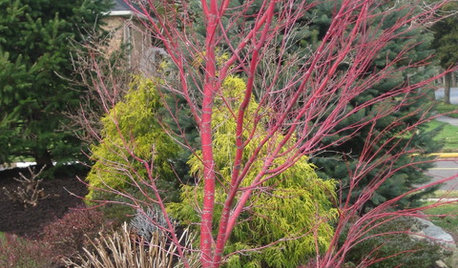
I was looking at the area, thinking about replacing it...... then decided the location would be gorgeous for a coral bark Japanese Maple. I would pull out the knock out rose and clean up all the dropped leaves.... probably would replace some of the soil with a mix for shrubs and trees.... If the disease spores (or whatever they are) remain in the soil, would it be likely to kill off the maple? Or is the maple more sturdy than the rose? Any thoughts would be very appreciated! My birthday is in October, and I usually ask for some plants or a tree. The coral bark maple would make a fun present, IF it will survive in this site. Thanks! |
Follow-Up Postings:
|
- Posted by ladywindsurfer Z7 SE (My Page) on Sat, Aug 28, 10 at 20:03
| The only fungal disease known, that affects JM's (and many other trees & woody plants), is Verticillium Wilt. It develops on the roots and blocks the uptake of moisture & nutrients to the foliage. Once it becomes well established, the tree will die. There is no known treatment or cure. Almost any of the JM's you purchase, is already infected with the disease, since propagators don't usually test rootstock before grafting. The one's in Oregon are particularly known for using dirty rootstock. That being said, you can usually prevent the disease from multiplying and seriously affecting the health of your tree. Select a location that is shielded from the sun during the hottest part of the day. Check any tree before purchase, for signs of disease, such as dead branches, curling or yellow (chlorotic) leaves. The Coral Bark JM ('Sango Kaku') is a good choice. Very colorful in the winter, with it's red bark. Mine is about 20 years old and it receives a "haircut" almost ever winter, to keep it in shape and height limited to around 8ft. It's at the drip edge of a White Oak and a Southern Magnolia. |
|
| In addition to the tips Ladywindsurfer gave, don't replace the soil. Amended soil is almost never beneficial and frequently detrimental to woody plants. The link below will give additional info. |
Here is a link that might be useful: Planting a Tree or Shrub
|
| "Almost any of the JM's you purchase, is already infected with the disease, since propagators don't usually test rootstock before grafting. The one's in Oregon are particularly known for using dirty rootstock." Ladywindsurfer, |
|
| Hey -- thanks! I think I will give this a try! |
|
| An additional thought. Verticillium wilt which is naturally present in soil enters a tree through cut/damaged roots. When planting JM's (and dogwoods) ignore the usual advice about teasing/spreading the roots. Set the soil ball into the planting hole and gently water around it to loosen the feeder roots without breaking them. Once planted never dig or edge under a JM. Never do anything which may cut a root. Mulch it and leave alone. If a ground cover is desired plant that at the same time the tree is planted. Anthracnose can also be a problem. The fairly new organic Actinovate fungicide will control it. Follow package instructions. |
|
| I don't think maples can get blackspot. It is for the rose family, which can include apple and pear trees. The only thing that has negatively affected my maples is that hard frost in Easter of 2007. Darn near killed them. Are you sure your knockouts had BS? I've heard of them getting powdery mildew bad, but not black spot. |
|
| Hey Buford..... It was some sort of funky crud! Leaves began to yellow and get black spots -- it spread throughout the plant. Then the stem ends got black also. I treated it with Bayer All in One (which I love, and which has always kept my roses really healthy.) But I think I was too late for that. It is dead as dead can be! Maybe it wasn't black spot, but I think it was some sort of plant disease. Icky. :) |
|
| I have two 'Sangu Kako' Coral Bark Maples and they are easy and very trouble free! Dig a big hole at least 2-4 times bigger than the root ball, so the soil is loose and will allow the roots to grow. Plant the root ball no lower than the soil level and maybe an inch higher for better drainage. Use only the native soil. Once planted, apply a nice hardwood mulch 2-3 inches deep, but keep it from contacting the trunk of the tree. Water long and deep at least once a week until established. Knock Out Roses are usually very trouble and disease free unless they are in soil that stays too wet. I have many and the only one that is not happy is on the bottom of a slope where it stays too wet. You are right to try to find a plant that will be happy in the site you have rather than keep some unsuitable plant alive with chemical intervention, and poisoning your garden. |
|
- Posted by tiku 7(tntsunchasers@hotmail.com) onSun, Sep 25, 11 at 11:22
| recently over the past few weeks i have noted a black mildewy discoloration at the base of my super nice sangu kako coral bark maple slowly creeping upwards. The leaves seem fine so far, but I am worried this will progress. I have sprayed an antifugal but does not seem to help. What do you think this might be? And more importantly how should i proceed? Thanks ! |
Please Note: Only registered members are able to post messages to this forum. If you are a member, please log in. If you aren't yet a member, join now!
Return to the Georgia Gardener Forum
Instructions
- You must be a registered member and logged in to post messages on our forums.
- Posting is a two-step process. Once you have composed your message, you will be taken to the preview page. You will then have a chance to review the contents and make changes.
- After posting your message, you may need to refresh the forum page in order to see it.
- It is illegal to post copyrighted material without the owner's consent.
- HTML codes are allowed in the message field only.
- No advertising is allowed in any of the forums.
- If you would like to practice posting or uploading photos, please visit our Test forum.
- If you need assistance, please Contact Us and we will be happy to help.