


Return to the Beans, Peas & Other Legumes Forum
| Post a Follow-Up
Bean plants very yellow
| | |
Posted by whidbeyislander z8 WA (My Page) on Thu, Jun 7, 07 at 16:15
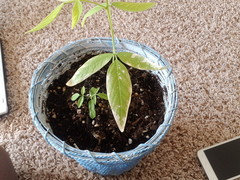
| I've never grown beans before, so I planted a bunch of different kinds of beans... most are pole beans. They just started comming up and now some are 3-4 inches tall, some are smaller, but I'm noticing that some of them are very very yellow. Does this mean that we're talking about some kind of soil defficiency? or some disease? Or are some bean plants like that? I mean it could be a nitrogen defficiency, that soil where they're planted is pretty crappy, but I thought that beans can get nitrogen from the air. Anyway, I sure hope they do ok, because I've never done this before. |
Follow-Up Postings:
RE: Bean plants very yellow
| | |
| I am hardly a bean expert myself, but I doubt that it is nitrogen deficiency. As you said they do get nitrogen from the air (ideally you should treat the seed with that bacterium that fixes the nitrogen they make into the soil). Possibly they are too wet and or cold? |
RE: Bean plants very yellow
| | |
| Based on the number of questions asked about this, it must be a fairly common phenomenon. One of those questions was asked by me and answered by zeedman last year in a thread about soy beans, which is linked below. The chlorosis on those beans eventually disappeared and the leaves became dark green. I'm currently seeing yellowing on newly emerged bush beans. There has been frequent rain with overcast days recently. I used no innoculent. I have not fertilized. I may give them one dose of soluble nitrogen, although that is probably not necessary. Jim |
Here is a link that might be useful: Chlorosis Question With Pic
RE: Bean plants very yellow
| | |
| Another reason for yellowing of bean leaves could be deficiency of micro nutrients like iorn etc.Chelated iorn does help in this kind of problem. It contains some more micro nutrients required by plants.I have been using this product regularly every year. |
RE: Bean plants very yellow
| | |
- Posted by kek19 5b-Michigan (My Page) on
Wed, Jun 20, 07 at 22:28
RE: Bean plants very yellow
| | |
| As an ex-Whidbey Islander (I was stationed at the Navy base in the 70's) I know how cool the summers can be there, with the cold wind blowing off the Sound... and the clouds can hang on for days. Neither situation is optimal for healthy bean growth. I only grew bush beans there, against the south wall of the house, where they benefited from the extra heat. If your weather has been poor lately, your beans are probably chlorotic (yellowed) as a result. Hopefully, when sun & warmth return, they will recover. Even if your weather has been good, as Jimster pointed out, legumes in general often go through a period of yellowing shortly after germination. The seeds have exhausted their stored nutrients, and the root system has not yet begun to supply adequate nitrogen. This situation is only temporary, and the plants usually green up in a week or two on their own... under ideal conditions. A single _light_ application of N (whether chemical or organic) at the time of planting will minimize the yellowing, and might be advisable for cooler climates, where bean growth tends to be slower. |
RE: Other suggestions
| | |
| Oops... forgot to give my other recommendations for Whidbey Island climate. Snap beans can be a struggle in the Sound - but there is another option. The English suffer from a similar climate, and grow runner beans instead (like Scarlet Runner), which are more tolerant of cool temperatures. They are prepared the same, and taste very similar. If you are interested, there are several threads in this forum that discuss sources. And if snap beans are difficult on Whidbey, limas are impossible. If you still want to eat large green-shelled beans, you might try favas. Like runner beans, they are cool weather tolerant... in fact, they prefer such weather. They should do well in your summers. Good luck! |
RE: Bean plants very yellow
| | |
| Fava beans and peas also do well in cool weather. |
RE: Bean plants very yellow
| | |
| Every time I plant beans, without fail, this is the process they go through: They come up nice and green. When the first set of true leaves come out, the plants start getting pale. Some of them border on yellow. The plants keep growing with their pale leaves. When they get about four sets of leaves, they start greening up again. Now, this is entirely my amateur interpretation of it, but I wonder if they come up nice and green because they're feeding on the nutrients in the seed, then get pale as they struggle a bit to gain hold, and finally green up again as their roots are colonized by rhizobia or as they become acclimated to their conditions. This process never happens with my peas, though. They come up green and stay green. I sometimes inoculate my legumes, but it doesn't seem to make a difference in the process except in time. The plants go through the same stages regardless of how long it takes. This year some plants (esp. Medinah) snapped out of the pale stage faster and when I pulled one up to have a look, it already had fat nodules on the roots with nice pink interiors. Plants that were still pale at the same time (Jumbo, Contender) had nodules when I pulled them up but they were small and not pink yet. A week or so later, those plants greened up, too. |
RE: Bean plants very yellow
| | |
| I think we're onto something. Yellow leaves on newly emerged beans are a common occurance and the beans outgrow it quickly. The yellowing I mentioned above, a couple of weeks ago, on my bush beans has disappeared. They are now a normal green color and doing fine. My Southern peas however, which initially were a dark green, now have a lot of bright yellow on them. Weather has been on the cool side for the past couple of weeks, which may be part of the reason. Based on the data which is accumulating here, I suspect they would grow out of it. I gave them a light application of calcium nitrate anyway. So now I've contaminated the data. We'll never know if it was the nitrate or if they would have grown out of it without help. :-) Jim |
RE: Bean plants very yellow
| | |
| I should clarify that when I mention peas above I mean English peas and snap peas (Pisum sativum). Those came up and stayed green the whole time. My cowpeas (Vigna unguiculata), on the other hand, went through the Pale Stage just as my green beans, although not as severely. |
RE: Bean plants very yellow
| | |
| There has to be something to to with the climate and or environment also. I have more than one planting of Tennessee Cutshort Pole bean this year, and just one of those plantings (16 feet of them) has been pretty yellow for a couple of weeks. Upon reaching about 3 1/2 feet in height they have started snapping out of it. Yet, the other plantings never yellowed. We have had lots of rain and cloudy weather. Plus, this particular planting got overgrown with weeds. I weeded them real well, last week (just before they started turning green again ;) George Tahlequah, OK |
RE: Bean plants very yellow
| | |
| Having the same situation here in Maui where there is no lack of sunshine. I started my pole beans in a big container, and transplanted against a wall with plenty of sun. They are starting to adjust and putting forth some new growth, but still yellow. Thought perhaps I was giving them too much water, but soil is just nicely moist. Hopefully, just a phase. Will just have to wait and see, but might also try the Chelated iorn suggestion. Nematodes and other soil parasites are sometimes to blame for problems here. |
RE: Bean plants very yellow
| | |
| I had the same beans symptoms so I tried alittle seaweed fertilizer to make nitrogen available without them having to work to hard. It worked great and after that they were fine. We're so trained to not fertilize young plants so we don't cause too much stress that maybe we don't really think about how it works. Beans don't work the same way other plants do so maybe we shouldn't treat them the same. |
RE: Bean plants very yellow
| | |
| "We're so trained to not fertilize young plants so we don't cause too much stress that maybe we don't really think about how it works. Beans don't work the same way other plants do so maybe we shouldn't treat them the same." A good point. We are also trained - with some justification - that we should avoid nitrogen for beans. While both of these "rules" are true for the most part, there are other factors to consider. Farmers locally lay a light fertilizer application on soybeans at the time of planting. I once thought that they were crazy to do so, that they were being duped by the chemical industry (I still believe they are). But it turns out that a light application of N increases bean germination, and helps the seedlings through the "N-gap" between consumption of the stored energy, and full function of the root nodules. I don't believe that such a treatment is necessary for the home gardener. As mentioned previously, most beans go through this yellowing, and come out of it on their own. By adding N, you run the risk of adding too much - and that leads to lush foliage, and few beans. But for those in growing beans in difficult conditions, such as cool weather or arid soils without irrigation, a light N application might be helpful, preferably one of a soluble nature. Whether natural or chemical fertilizer is used, my recommendation is that it should be a highly-diluted, one-time application at the time of planting. If too much is used, and the fertilizer persists in the soil until plant maturity, it will adversely affect the yield. |
RE: Bean plants very yellow
| | |
| This is the third year in a row I've experienced the early yellowing of legumes. Like last year, when they were about 5 inches high the leaves of my Pinkeye Purple Hull peas became bright yellow over nearly 50% of their area and were very crinkled. I applied soluble plant food and, in less than a week, they are greening up and flattening out. The condition was so severe that it was hard believe it could be the result of a nutrient deficiency. So I did a lot of searching and reading about virus. But, now that the fertilizer is remedying the situation, it is apparent that it was a deficiency. Since I used a complete fertilizer, it is not known whether the deficiency was of nitrogen or of some trace element. Based on previous experience it was probably nitrogen and I am buying zeedman's N-gap theory. I wish I had a better understanding of how those root nodules work, in particular the timing of when they start to provide N to the plant. I was negligent in not photographing the yellow, crinkled condition. It was vivid and ugly. Hard to believe the established leaves could grow out of it. Next time. Zeedman or anyone else, are you growing Purplehulls? If so, how does your experience compare? Jim |
RE: Bean plants very yellow
| | |
| Jim, the weather locally has me almost a full month behind schedule. My city has been declared a Disaster Area due to flooding!!! My main garden was completely under water only two weeks ago!!! Very frustrating, as you can well imagine... all the more so because it sets back my preservation schedule. Not much can be grown for seed in the time remaining. I'm hoping for a warm spell in late Summer, so at least a few of my beans & soybeans will mature - including yours. The Purplehulls you sent me were planted only a few days ago, and have not yet germinated... they should appear within the next few days. Since my experiment last year showed that cowpeas respond well to the appropriate inoculant, I applied it heavily to the seeds at the time of planting. I'll keep you posted. |
RE: Bean plants very yellow
| | |
| That is a sad tale, zeedman. There is hardly anything so discouraging to a gardener as losing a growing season, or the better part of one, after planning for it all winter. It's tough to say "Oh, well, there is always next year". Next year is a long way off. Sorry to say, I blew it on the inoculant experiment. Your results have me interested. "Oh, well, there is always next year". As for experiments, I now think it would be easy to do a conclusive experiment regarding N-gap and settle that question once and for all. Jim |
RE: Bean plants very yellow
| | |
| This year (basically the same weather as Zeedman, but a tad warmer and a bit drier) for the first time EVER I have yellow first leaves on my Gransma Nellie's Mushroom Beans. the plants are 4' tall and growing well otherwise. I will give them a very light treatment of N and let you know if it helps. |
RE: Bean plants very yellow
| | |
| I have a couple of self watering containers of beans in a greenhouse. The plants are very large, bright green, and there are many pods. They are growing in half potting mix and half compost with some lime and organic mixed fertilizer. The same varieties growing outdoors are not doing nearly as well. And in one bed of NT Half-Runners, one end looks healthy and green and the other end is more yellow and the plants are smaller. According to a basic home soil test kit, the better end has a pH of about 6.8, low N, low to medium P and medium to high K. The chlorotic end has a pH of about 7.0, low N, low P, and medium to high K. The main difference is the lower P. Our night temperatures in mid-summer average around 52F. The greenhouse plants have an advantage in both day and night temperatures. Some varieties also seem to thrive more than others. Possibly some tolerate cooler nights better than others. |
|
|
|
|