

|
Follow-Up Postings:
|
- Posted by wordwiz (wordwiz@fuse.net) on Sat, Apr 3, 10 at 23:12
| OMG, we better shade our tomato plants growing outside in the garden in summer! The only way this post could be more valuable is if you had posted it two days ago, on April 1! Mike |
|
- Posted by urbangardenfarmer (My Page) on Sat, Apr 3, 10 at 23:15
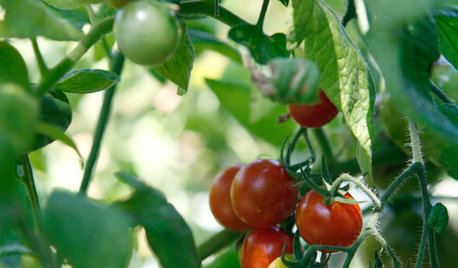
| Look kinda like this? I've been wondering what these are. They start out like blisters on the bottom of the leaves. As the days go by, they dry out and turn to dead spots.
|
|
- Posted by struwwelpeter 5 (My Page) on Sun, Apr 4, 10 at 10:16
| There is a BW picture of the tumors in Evidence for Involvement of Phytochrome in Tumor Development on Plants (PDF).
|
|
- Posted by struwwelpeter 5 (My Page) on Sun, Apr 4, 10 at 10:39
| Two things are noteworthy. 1. The susceptible tomato plant was Lycopersicon hirsutum. 2. Unfiltered fluorescent light has enough ultraviolet from the mercury spectrum to prevent those tumors so you don't have to worry about it when using fluorescents. BTW, I have the same kind of red (Sylvania 236) and far red (Sylvania 232) fluorescent bulbs that were used in that study. I forgot which (I have about a dozen different kinds) was the far red but that paper refreshed my memory and gave me a spectral distribution chart which is certainly useful to me. |
|
- Posted by organic_oddity (My Page) on Mon, Apr 5, 10 at 14:05
| Newer studies (2009, not 1989) show that it's most likely a bacteria causing the problem. It's possible, I suppose, that far red light kills the bacteria (or other organic organism), but I don't think it's an abundance of one/lack of one that causes it. Agreeing with Mike (WordWiz) that if this were the case, our outdoor plants would suffer as well. |
|
- Posted by struwwelpeter 5 (My Page) on Tue, Apr 6, 10 at 10:47
| Agreeing with Mike (WordWiz) that if this were the case, our outdoor plants would suffer as well. If you two had properly read the paper, you would have understood that ultraviolet light prevents tumor formation outdoors. |
|
| These links have something to do with this subject: http://plantphys.info/plant_physiology/phytochrome.shtml http://users.rcn.com/jkimball.ma.ultranet/BiologyPages/P/Photoperiodis m.html |
|
- Posted by organic_oddity (My Page) on Tue, Apr 6, 10 at 14:10
| @struw - do some additional research (something preferably less than 20 years old). Tumors are caused by a combination of bacteria and genetics. The spread is increased due to deficiency in moisture, nutrients, and - yes - the light spectrum. Simply bathing your plant with some UV light will NOT completely prevent tumors. @yucatan - yeah, I've been researching as well, and see that plants need the entire spectrum to some extent, though extremes/deficiencies in certain areas will definitely affect development. |
|
- Posted by struwwelpeter 5 (My Page) on Tue, Apr 6, 10 at 17:11
| @struw - do some additional research (something preferably less than 20 years old). It is incumbent upon you to cite references instead of mindlessly pontificate. |
|
- Posted by wordwiz (wordwiz@fuse.net) on Tue, Apr 6, 10 at 17:49
| It's not incumbent on you to post modern datum, but it might contribute to your credibility a bit. What's your next post going to be? That the world is flat based on "current beliefs"? Mike |
|
- Posted by struwwelpeter 5 (My Page) on Wed, Apr 7, 10 at 10:23
| Most typically, experimental observations do not change with time. More frequently, the analysis of those observations change with time. I cite scientific papers mostly as sources of experimental observations and not analysis. What you do with those observations and analysis is your responsibility. |
|
- Posted by organic_oddity (My Page) on Wed, Apr 7, 10 at 17:57
| @wordwiz while it is not incumbent upon him, if he wants to be helpful, he should post the BEST EXAMPLE AVAILABLE at the time. Otherwise he's going to irritate people like me who are trying to learn and ultimately be able to pass on knowledge. I initially read this, said "WTH?", and started doing more research, only to find it's another of struw's infatuation with incandescent lighting. @struw - Thank you for referring to me as mindless. I prefer to suggest that I was paraphrasing the information I'd found, and upon additional research could add "wounds" and "virus" to the list. However, you are absolutely right. Pot/kettle and that sort of thing. Let's start here. And here. I found that one really informative actually. And here's one I'd like to get more information on, as several newer studies cite it. But I'm too cheap to pay for the articles. Here's more. So tell me - is UV light the cause of tomato tumors? |
|
- Posted by wordwiz (wordwiz@fuse.net) on Wed, Apr 7, 10 at 18:48
| OO, I've read dozens and I mean multiple dozens of articles on far red light. Yes, plants need some of it, just as the need some green and yellow. But not enough to warrant adding a ICD bulb - almost all grow lights except LED will provide enough. The biggest thing adding excess far red light does is cause stem elongation. If it was of high priority to photosynthesis, the leaves would not filter it out and pass it on to the stems. I'm sorry, but I see so many posts by struw proffering far red light as a magical panacea that I would not be surprised to one saying how it increases bedroom activities! YMMV, Mike |
|
- Posted by struwwelpeter 5 (My Page) on Thu, Apr 8, 10 at 10:57
| Let's start here. And here. I found that one really informative actually. And here's one I'd like to get more information on, as several newer studies cite it. But I'm too cheap to pay for the articles. Here's more. Those articles do not apply to the kind of tumors in the paper I cited. If those articles did apply to those kind of tumors, it would be incumbent upon the authors of those articles to cite older relevant articles in their bibliographies. If you Google, "Evidence for Involvement of Phytochrome in Tumor Development on Plants" , you will find only a few articles that cite that paper. So tell me - is UV light the cause of tomato tumors? According to that paper, even a small amount of UV B suppresses those kind of tumors. That suggests that the only time someone is likely to see those kind of tumors is with certain tomato varieties grown under HPS or LED and, those tumors are unlikely to be seen on plants grown under MH, fluorescent, or daylight.
|
|
- Posted by struwwelpeter 5 (My Page) on Thu, Apr 8, 10 at 10:59
| "those kind of tumors" should be "that kind of tumors" |
|
- Posted by organic_oddity (My Page) on Thu, Apr 8, 10 at 13:25
| Agreed Mike - on several levels. @ struw - What - non-pathogenic tumors? Bacteria can be non-pathogenic. As far as I know genetic mutation is non-pathogenic, though it could be argued that you have to have a trigger, such as lack of UV light to turn it on, which is perhaps where they were going with it, but that's not stated in the article. And there are no additional studies to confirm this. The only one that comes close was done by Tibbitts in '83. And as far as citations, fine. Here's one. This one (which "cites" Morrow and Tibbitt's work) offers the following: "specifically, intumescences At the beginning it states that M&T (among others) wrongly portrayed these to be tumors and that they are instead blown up cells. While light temperature "may" promote or inhibit this effect, the main culprits are humidity and temperature. And I've spent more time than I care to on this. I wont' even vouch for this study, but I do feel an obligation to block bad science/advice when I see it. And I personally think this post pretty much falls into those categories. I'd hate to think of all the newbies (not unlike myself) trying to figure out how to wire up small halogen lights to their fluorescent fixtures. |
|
- Posted by struwwelpeter 5 (My Page) on Thu, Apr 8, 10 at 18:17
| At the beginning it states that M&T (among others) wrongly portrayed these to be tumors and that they are instead blown up cells. Yes, they pontificated instead of proved it (like you do). Pinkard et. al. fail to address Tibbitt's statement, "However, previous work done in this laboratory (11) indicates that water congestion does not induce neoplastic growth, but makes tumor development only more pronounced." I'd hate to think of all the newbies (not unlike myself) trying to figure out how to wire up small halogen lights to their fluorescent fixtures. You must be hallucinating because there is no such advice in this thread. Also, clear thinking people would have said "like" instead of "not unlike." I do feel an obligation to block bad science/advice when I see it. And I personally think this post pretty much falls into those categories. I have no idea why you think that you are qualified to judge. |
Please Note: Only registered members are able to post messages to this forum. If you are a member, please log in. If you aren't yet a member, join now!
Return to the Growing under Lights Forum
Instructions
- You must be a registered member and logged in to post messages on our forums.
- Posting is a two-step process. Once you have composed your message, you will be taken to the preview page. You will then have a chance to review the contents and make changes.
- After posting your message, you may need to refresh the forum page in order to see it.
- It is illegal to post copyrighted material without the owner's consent.
- HTML codes are allowed in the message field only.
- No advertising is allowed in any of the forums.
- If you would like to practice posting or uploading photos, please visit our Test forum.
- If you need assistance, please Contact Us and we will be happy to help.