

Return to the Native Plants Forum
| Post a Follow-Up
Another native restoration (photos included)
| | |
Posted by topie 6b (My Page) on Tue, Aug 11, 09 at 18:16
Were starting on another native restoration project for an area of our land, and was wondering if anyone can help answer a couple of questions about native habitats.
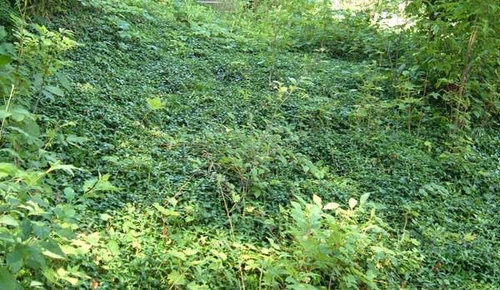
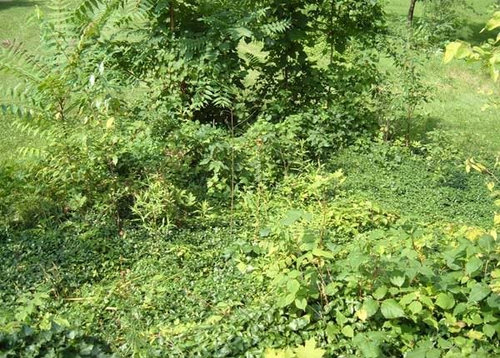
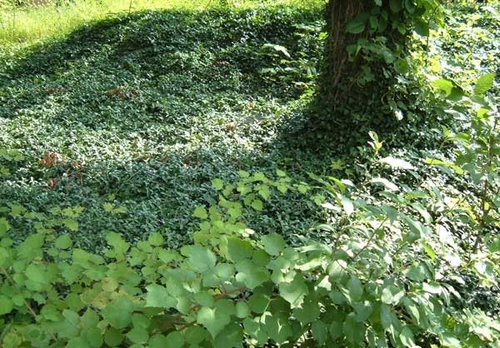
The area we'd like to restore native plants and shrubs to is a large slope which is sitting at the foot of a long cinderblock retaining wall. The entire area is currently carpeted by Vinca minor, and English ivy, both planted by the previous owner of our house (see photos). We'd definitely like to remove the Vinca Minor, and possibly the English ivy as well.
The slope is in a riparian buffer area, not on the banks of the stream itself, but within less than 50 feet of a ravine which leads down to the stream. The soil is has a moderate clay content mixed with shale rocks, and is fairly moist.
Here are our questions:
Sunny section of slope: Should we think of this as a moist thicket, open woods, or meadow? The sunny area is in full shade until about noon, when it becomes a full sun area until dusk. Natives that have self-seeded at the edge of the sunny section of the slope currently include: Black Walnut saplings, Yellow birch saplings, poison ivy, and a very young unidentified conifer, most likely Eastern red cedar.
Shaded section: Should we think of this as dry woods? At one end of the slope is a non-native Norway Maple which keeps that area of the slope in dappled shade all day (the Norway maple overhangs our property, but the trunk isn't on our property, so we can't cut it down). Non-native shrubs in the shade area include Japanese winebery. We're thinking of the shaded area as dry woods due to the roots of the Norway maple, but aren't certain how dry it really is. Natives that have self-seeded in the shaded section of the slope currently include: Virginia Bluebells (Mertensia virginica), and poison ivy.
We’re in Zone 6b, in the Northern Piedmont area, inland from the East Coast.
The "sketch" below pretty much shows the approximate placement of everything where it is right now. Definitely a "Before" sketch, not an "After" !!!
Any help with pinpointing these habitats would be appreciated. Thanks in advance!

|
Follow-Up Postings:
RE: Another native restoration (photos included)
| | |
| P.S. The soil in this area is a moist, well-drained clay loam with an acidic PH between 6.0 and 5.0 I'm thinking that "woodland edge" or "open woods" is the most accurate description of this habitat??? We'd like to go with a shrub like Summersweet, Winterberry, Virginia Sweetspire, or Lowbush Blueberry in the sunny area (we may transplant the Black Walnut saplings to a different spot). But please let me know if anyone thinks it should be re-planted more as a "meadow" instead. Again the photos above are PRE-native restoration, not POST-restoration. We are working on eradicating all the Japanese Wineberry right now, which seems to be xtra-invasive this year. Didn't plant that one either. I guess the birds bring in the seeds in their droppings. Thanks. |
RE: Another native restoration (photos included)
| | |
| You really have a host of possible options on what you may want to do. It all depends on the amount of time you want to expend in creating your distinct habitat and what kind of elements you may wish to include, such as wet spots or running water. What is most important is learning just how much space each plant or group of plants will require in order to grow well and how compatible they are with each other. Below is a list that may be helpful in isolating what your best plant options may be for your project. |
Here is a link that might be useful: US Fish Wildlife listing of natives to Piedmont, Maryland
RE: Another native restoration (photos included)
| | |
| Thank you so much for your reply and for the US Fish Wildlife listing of natives to Piedmont, Maryland. The list is great! I've been researching the same plants, trees and shrubs as the ones that are on the list, so it's good to know I'm on the right track, and it's terrific to have a listing with everything in one place. I'm thinking at this point that the habitat on this slope is more of a wood edge than a potential meadow. However, the edges of the slope border a lawn, so I think we'll consider the edges of the slope as meadow for now, until the trees and shrubs get taller. I think we'll concentrate on the regeneration of the trees and shrubs first. Thanks again for the great link! The info is really appreciated. -topie |
RE: Another native restoration (photos included)
| | |
| Hi, Topie. Others can probably give you much better advice about what to plant in your area. However, I am really curious as to how you plan on dealing with the vinca? I also have been battling this plant for years now. We have tried smothering, burning, manually digging, Brush B Gone, Roundup. It is very persistent. If even one little piece of root survives, the stuff comes back. It is even harder to deal with when it is mixed in with natives. Our problem is that it covers a large area and can come back before you notice. It is really a plague for us. Good Luck with your project. RW |
RE: Another native restoration (photos included)
| | |
| hi rootwad, that is a good question about the Vinca. I think "plague" is a good word for Vinca. It always amazes me that on other forums that people are actually trying to get it to grow. We're planning on manually removing it, but I've heard the same thing... that it is very difficult to get rid of. Thanks for sharing your experiences with it. I have the feeling I'll be out there a lot yanking it up. Because of the Vinca issue, I'm thinking we should install a stepping stone pathway on this slope to make getting around the slope for Vinca removal easier... Have you attempted to plant a native ground cover instead? I figure the Vinca is probably difficult for native species to compete with. We're thinking of trying Foamflower, Wild Ginger and some colonizing ferns in the shady area, but not sure if they'll be able to drown out the Vinca. Haven't figured out a native ground cover for the sunny areas yet...maybe wild strawberry? Thanks for the good luck wish! |
RE: Another native restoration (photos included)
| | |
| I also have a horde of Vinca growing happily in the side yard under a large Norway maple. I've removed tons in other parts of the yard to make gardens, mostly via digging and smothering. Digging is hard, smothering is relatively easy. First I scalp it by mowing it down as low as possible, then smother with cardboard topped with layers of organic material (i.e. lasagne gardening or sheet composting). Be sure to overlap the cardboard well or it will grow through. This does indeed kill the Vinca and as the layers decompose it will create a nice rich bed for planting. In defense of Vinca minor, it can be useful in a hard to grow and contained location, and it's attractive. But in my experience it is very aggressive and will choke out pretty much everything except for mature established shrubs and trees, native or not. I also had 5 large Norway maples, but have had 4 of them removed (1 huge one left). Even for a maple, they are particularly difficult to grow underneath, as they cast a dense shade, and have mildly allelopathic roots that will suck all the moisture out of the ground. Some natives that will grow in dry shady or open woodland include White wood aster (Symphyotrichum divaricatum), Blue wood aster (S. cordifolium), White snakeroot (Ageratina altissimum), Woodland sunflower (Helianthus divaricatus), Northern sea oats (Chasmanthium latifolium), Viola, and possibly native Columbine (Aquilegia canadensis). I'm sure there are others. You should conider moving the Juglans nigra as they have very allelopathic roots and are difficult to grow under. They also eventually grow into very large trees with wood that is quite valuable. |
RE: Another native restoration (photos included)
| | |
| Thanks so much for the Vinca eradication tips. I think we will try that smothering/lasagne method in certain spots because the Vinca covers a fairly large area. I agree Vinca can be useful in certain situations. We have some growing near our house foundation...it seems to stay contained by the lawn, and the evergreen aspect is a plus. It's just not so great on this slope area because it's really getting into the riparian buffer zone at this point, and is starting to grow into the woods. Thank you also for the native dry shade recommendations! We'll definitely keep these in mind for the area under the Norway Maple. Yes, right now we're looking into moving the Black Walnut saplings. We have lots of them here...but can't bear the thought of cutting down a native tree, so hoping we can transplant. Seems difficult to transplant them because they have such a deep taproot...I agree they do make a nice tree though eventually. Hopefully we can move them to an alternative spot in the yard. Thanks again for everyone's suggestions. The info is really appreciated. Hope to post the "After" pictures someday... |
RE: Another native restoration (photos included)
| | |
| The resolution is quiet simple.Plow it up and replant whatever you'd like |
Here is a link that might be useful: tn nursery
RE: Another native restoration (photos included)
| | |
| You may want to rethink keeping the black walnuts anywhere near your restoration. The soil under black walnuts is permeated with juglone from the roots, which is highly toxic. It is poisonous to many plants, including blueberries. |
Here is a link that might be useful: Ohio State Extension: Black Walnut
RE: Another native restoration (photos included)
| | |
- Posted by jpal MA 6 (My Page) on
Fri, Sep 4, 09 at 1:22
| You may want to take Tsons advice with caution as they seem to be associated with Tnnursery (aka: D&Tnursery, Tennesee Wholesale Nursery) which has decidedly mixed reviews at Dave's Garden watchdog page. Read some feedback- http://davesgarden.com/products/gwd/c/2281/ Apparently people from the company are posing as consumers and touting the company in reviews. Tsons seems to have decided to start participating in our Natives discussion here at Garden Web. |
RE: Another native restoration (photos included)
| | |
| Thanks jpal for the tip and the link...do they sell plows? Maybe they're trying to get me to buy some of their garden equipment to "plow up" all the vinca, lol. Thanks but no thanks Tson, or should I say Tennessee Wholesale Nursery. Anyhow, always am excited about a new spot to restore with natives...we're starting with planting the shrubs in the fall. Found out we can transplant the black walnut to another spot, so that's good news...no more juglone patch. |
RE: Another native restoration (photos included)
| | |
| Hi, again Topie. Sorry for my lack of response but I lost track of this thread and just found it again today. I used a heavy section of pond liner on one area. I left it in place for a year and thought it had worked but the stuff has come back after a couple of years. I'm currently working on manually eliminating it since the garden is planted with several different natives. The groundcovers you mentioned will succumb to the vinca. Anyway, that's been my experience. I still think the smothering may be the way to do it, but I think it will be a long term solution. I have a large area (about 1/4 acre) where the vinca is starting to encroach to the woods. This fall before leaf fall we plan on burning it and then spend the next several years smothering it with a heavy covering of oak leaves (blown with the back pack blower to 2 or 3 feet). I know that plowing will simply divide the roots and create more plants. I believe that eradicating the vinca is going to be your biggest obstacle to creating a native woodland. I'm determined that my place doesn't become a vinca monoculture but it's been a battle. RW |
RE: Another native restoration (photos included)
| | |
| Thanks RW for the follow-up on the vinca info. Wow, it sounds rather nightmarish to get rid of. The burning/leaf smothering method sounds hopeful. Good luck! I think we'll try a combo of manual pulling and smothering with cardboard and organic matter for now and see what happens. Based on your info, it sounds like it's better for us to wait to plant any perennials until the vinca is eradicated. Seems like eradicating will take several seasons. I think we should remove the vinca in sections maybe. Hopefully the shrubs we're planting this fall will be ok...I guess we'll just have to be vigilant about keeping a vinca-free area around each shrub. Thanks for the tips...it helps so much when someone shares their practical experience with techniques for these types of projects. |
RE: Another native restoration (photos included)
| | |
| If the goal is to eliminate a groundcover like Vinca, I would personally use glyphosate assuming there is nothing else that I wanted to save. Restoration ecologists use it frequently because it is less hassle and more effective in the long run. If there is woody vegetation present it can be worked around. |
RE: Another native restoration (photos included)
| | |
| You know, Topie, when I read lycopus' post I got to thinking. I have tried glyphosate, but, my woodland gardens are over 20 years old and huge maybe all told around 3 acres. I have been fighting this stuff around established plantings that I didn't want to destroy. Also from 2000 to 2007 I was dealing with ill parents. Between that and my job I was barely in the garden at all except to enjoy it on the few weekends that I was home. The vinca really took off during that time. The last couple of years I've been fighting a number of problems, the vinca beng the worst. I would try lycopus' suggestion because you can work around your woody shrubs. Then in the spring see what you have, if any, left. I haven't wanted to face this solution because I really don't want to start over again. Let us know how you do with this invasive. I am particularly interested in your progress. I may have to bite the bullet and do the same thing. What misery! RW |
RE: Another native restoration (photos included)
| | |
| This is not related to the topic, but I wanted to type these words: Wetland Supplies. Researching Wetlands Supplies online at Dave's Garden suggests that is the new name of TN Nursery. Hopefully this off-topic post will help the next person who is looking into ordering from them. I have no experience with the company, but people deserve to know IF a company is just changing their name to avoid bad reviews online. |
RE: Another native restoration (photos included)
| | |
| Hi Topie. How are you doing with vinca eradication? |
RE: Another native restoration (photos included)
| | |
| Hi Rootwad, Well, we went to plant Winterberry shrubs a couple of weeks ago, started to remove the vinca, and almost gave up on the whole project. The vinca roots in this spot seem to be much more firmly entrenched than another patch of vinca close to our house, which I've been able to just pull up here and there as I've planted things. The vinca must be loving the soil in this spot...the roots were very thick and went down at least 6 to 8 inches into the ground. I actually found myself looking around our property trying to figure out somewhere else to plant the Winterberry. But basically, we just dug the vinca out, and once we got past the vinca, we discovered really great, dark brown soil which tested as acidic with the little PH tester kit from the hardware store. After hours of vinca uprooting and much mulching, the Winterberry is now in place and is wonderful. We were kind of cursing the vinca the whole time, of course. I think for the next few seasons this area will just be populated by shrubs and vinca, because I can't imagine any herbaceous plants thriving in it. But I do still plant to pull up some more vinca that's getting close to the woods at the slope's edge. How is your vinca eradication going? -Topie |
RE: Another native restoration (photos included)
| | |
| I'm still digging. The roots are rather amazing and it seems like if you leave even a piece, it grows. The area you're working on sounds like a really good place for woodland plants. Tackling the vinca is a good thing to keep it out of the woods. And you're right, anything besides the shrubs can't compete with the stuff. RW |
RE: Another native restoration (photos included)
| | |
| Just a quick note to say that the allelopathy of Juglans spp. is vastly overrated. Some popular alien ornamentals can't survive under black walnuts, but many natives do just fine. Here's a link w/ a list: http://www.wildlifegardeners.org/forum/woodies/1638-anyone-growing-nj-tea-w-black-walnut.html |
Here is a link that might be useful: Juglone tolerant natives
RE: Another native restoration (photos included)
| | |
| I have seen that list, too. It's very helpful and has helped me in planning. That is a great site. |
RE: Another native restoration (photos included)
| | |
| amalanchier, thanks so much for the link. It IS a great site. RW |
Post a Follow-Up
Please Note: Only registered members are able to post messages to this forum. If you are a member, please log in. If you aren't yet a member, join now!
Return to the Native Plants Forum
|
|
|