



What is your favorite 'Flower Power' or bloom booster fertilizer?
This year I have to admit I wanted to see more inflos on my trees but I am seeing more trees blooming than last year.
I asked a good plumie friend of mine and she swears by Foliage Pro..she said her plumeria are blooming like crazy!
I like FP and use it often, but I am wondering what others use here?
Thanks,
Andrew
Comments (73)

lablover4ever
11 years agolast modified: 9 years agoall the plumeria websites tell you to use high middle numbers so thats what i've been doing. should i change now or wait next spring? my bigggest ones are 5 years old and they bloom really good using it.

Dave in NoVA • N. Virginia • zone 7A
11 years agolast modified: 9 years agoWow George, the bougainvillas are incredible!
So to get bougs to bloom well, you recommend potbound and fertilizers, also pruning back in Fall or early Spring?
What about letting them dry out for a spell in summer to initiate blooming?
Dave
Related Professionals
Birmingham Landscape Architects & Landscape Designers · Brentwood Landscape Architects & Landscape Designers · Hershey Landscape Architects & Landscape Designers · Fort Myers Landscape Contractors · Hilton Head Island Landscape Contractors · Kailua Landscape Contractors · Medford Landscape Contractors · Placerville Landscape Contractors · Thornton Landscape Contractors · Whittier Landscape Contractors · York Landscape Contractors · North Aurora Landscape Contractors · Longmont Siding & Exteriors · Millburn Siding & Exteriors · North Richland Hills Siding & Exteriorshoneybunny2 Fox
11 years agolast modified: 9 years agoGeorge, thanks for posting information about bouganvilla. I planted mine in 1996, and never knew they bloomed on new growth until this year. My poor plants do not get ferterlized, except when my husband puts down Alfa meal and molassas in the spring. I been reading how eveyone feeds their plumeria with foliage feeders and granular fertilizer. I felt bad, that my plants are not getting anything. I have sheep manure, but have been afraid to put on my plumeria, after it burnt my amaryllis. This past Monday I put down 12-24-12 recommened my the local nursery. My husband has 2 gallons of Medina Hasta Grow in his garage. I really don't know what he uses it for, I am thinking about using it as a folage feeder for my plumeria, what do you think? Barbra
elucas101
11 years agolast modified: 9 years agoAl, thank you so very much for taking the time to respond to my post, I sincerely appreciate information and the time you put into that. It makes perfect sense the way you explained it! Very, very good info.
That's a good point, we can do whatever pleases us to do with the plants, although it's good to know what the ideal is for the plant and then be able to manipulate it how we want. So in that sense, the nutritional manipulation would point back to using something other than, say, the Foliage Pro to promote greater blooming? And if so, what would you recommend?
George, those bougainvillea are incredibly beautiful!!!
wally_1936
11 years agolast modified: 9 years agohoneybunny2 Why don't you make manure tea? 10 to 1 should help prevent burning if it isn't too fresh. Or if the plants are in your soil side dress to avoid burning.
AllanRandall
11 years agolast modified: 9 years agoHey mike, thanks for your response. I was actually surprises to see anybody in Oklahoma growing plumeria. I'm glad to hear that the group is quickly growing. However, I have to say that if this crazy heat trend keeps up, the group my be minus one before long. I don't know if it gets worse every year, but I do know that I hate it more every year.
honeybunny2 Fox
11 years agolast modified: 9 years agoWally, I have been using sheep manure tea on my daylilies and hibiscus, they love it. Since most of my plumeria are new and in pots, I am to scared to try the manure tea on them. Next year they will go into the ground, so I will be more open to the idea. Barbra
citizen_insane
11 years agolast modified: 9 years agoHi Al,
with all due respect but I totally disagree with you. If you are talking about oak trees, what you said is true. However, for plants with relatively small rootball, like plumerias and bougainvillas, I do not agree with you. And the relative size of the pot makes all the difference in the world. If you are talking about a plumeria being root bound in a one gallon pot, what you said is true. If you are talking about a plumeria in a 35 gallon pot, it is not true.I used to grow bougainvillas in 25 gallon pots. In the springtime they grew branches as much as 15' long, with lots of leaves and no flowers. I planted a bougainvilla in a flowebed with citrus, where it was getting too much nitrogen, and it towered 10' above the fence. It never did make a single bloom.
The best bougainvillas I have seen are in rocky Greek islands. They grow in cracks in the rock with little soil and little water (does not rain in the summer) and they make huge spreads and bloom like you have never seen. Here is an example in the picture below.You thing anybody ever fertilizes this plant?

When bougainvillas bloom they make flowers on little branches and not on strong new growth (what I call water suckers). Just like in the picture below in a Greek Village on the mountains.
Here is a picture of the bougainvilla I showed blooming earlier, after it has finished blooming.

Now, here it is blooming. Notice how many blooms all these little branches have on them.
Here is a vigourous branch, even with a root bound bougainvilla. This branch will make a few flowers at the tip and that is it. You do not want bougainvillas to grow like this. That is why they do best when root bound!!!
You cannot look at things as black and white and say root bound plants are bad. Everything is relative.
tc,
Georgecitizen_insane
11 years agolast modified: 9 years agoHi Dave,
I water all my plants automatically by using vinyl hoses and punching holes in it with a thumb pin. The bigger the plant, the more holes I punch. This way I give each plant adequate water. During the summer, I water my plumerias and bougainvillas every day for about 7 minutes. I give just enough water so some comes out the bottom. I make a special mix for potting bougainvillas that contains a lot of sharp sand, paumice, and perlite (plus potting soli). It drains real well and they dry out in the heat evety day. If I do not water for a day their leafs droop.Another key to fertilizing is timing. I fertilize mine right after flowering. This induces new growth and they will flower again shortly. Just use a low nitrogen fertilizer to avoid too vigorous growth.
With respect to the Medina product, I heard some good things about it from other plumeria growers. I have no experience with it. I use mostly granular fertilizers.
tc,
Georgetdogdad
11 years agolast modified: 9 years agoGeorge- one thing you can do to increase the vitality of your plant is to take a key hole saw and saw straight down about three inches from the outside of the pot. Take a large spoon or a narrow trowel and dig out the soil and roots outside the cut. Saw deeper, remove more. When you get to the bottom of the pot you have two choices. 1. lean over the pot and slide out the root ball and cut a few inches off the bottom then replace a few inches of new soil and slide back into the pot, stand up and fill new soil all around the edges, or 2. just fill the new soil around the edges without removing the plant. 1 is best but 2 does give the roots new growth and cuts off many of the compacted roots.
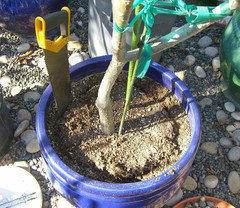
Uploaded with ImageShack.us
this photo shows not a key hole saw but a saw I ground the back to a point so I could go deeper in one segment. The key hole turns easier but you need several steps to get to the bottom.
tapla (mid-Michigan, USDA z5b-6a)
11 years agolast modified: 9 years agoSmall rootballs don't stay small, and a rootbound plant in a large pot is still root bound and suffers the same stress as a root bound plant in a small pot. There is nothing in pot size that eliminates or eases the stress of tight roots.
I have collected plants from the wild that grow in crevices and cracks or duff in a small depression in the rock. I have a black hills spruce that has a trunk thickness of only about 1.5", and the forester that collected it (does timber surveys for the dept of the interior) from a crevice estimates it's age to be in excess of 300 years old.
I repotted 2 bougainvillea this summer that were rootbound. In both, growth was virtually nonexistent because they were badly rootbound. By chance, both were given to me by 2 former members of our bonsai club who were unable to care for them properly - one because of old age, the other time constraints. After repotting, the plants took off and have grown more in the last week than during the entire previous growth cycle.
I've seen the same response in literally thousands of plants I've repotted, some in containers as large as 50 gallons. There is nothing other than anecdote that would cause anyone to believe that plumeria or bougainvillea are immune to the effects of tight roots. Nurserymen make it a point to pot up plants before the root/soil mass can be lifted from the can intact because of the ill effects of tight roots on growth, vitality, and ultimately their bottom line.
I was cautious to allow that the stress of tight roots can induce more abundant blooming to a point; but while this makes the grower happy, it is actually the plants unhappy response. There is a clear distinction in those perspectives, and looking at blooms as a sign of a plant's state of health is a mistake. Plants will bloom as long as they have enough energy to sustain themselves. Growth is the more realistic measure of a plants vitality, and by growth I mean the increase in a plant's dry mass, not branch extension or the appearance of new growth that comes as a result of the plant robbing nutrients from older foliage. Simply put, growth wanes as root constriction increases - vitality accompanying it. There is no getting away from that fact, and simply saying it isn't so doesn't make it so.
In order for a plant in a large pot to not suffer the effects of tight roots, you would have to be saying either that A) plants in large pots don't get root bound, or B) being root bound in a large pot has no effect on the plant. I can't imagine how either argument can be supported, and can't envision another.
I explained WHY being rootbound impacts growth and vitality, but essentially you said you disagree, but not specifically what you disagree with. Maybe we can work this out if you'd like to be specific. If you do decide to elaborate, please explain what leads you to believe "...the relative size of the pot makes all the difference in the world." My considerable experience repotting large plants is very different, and I can explain clearly why it's different.
I'm not trying to change your mind, but for others following along, I'd hate for them to get the impression that any (species of) plant in any size pot is immune to the effects of root congestion. W/o question, plumeria, bougainvillea, oak trees and petunias all respond in predictable fashion to root congestion.
Take care.
Al
citizen_insane
11 years agolast modified: 9 years agoHi Al,
If I re-pot that Atzec Gold plumeria and prune the roots back, it will grow a lot more than 2"" per year and it will overgrow my patio cover in a few months. Then I will have to prune it back. Tall growing plumerias, like Atzec Gold and Vera Cruz Rose, do not respond very well to prunning. Here is an Atzec Gold plumeria that was cut back. Look at how fast those new brances grew (look at the space between the leaf internodes). Not only that, the new branches are thin and bended down under the weight of the leafs.
Not only that, they do not flower very well on the thin new branches. They flower much better on slow growing thick branches. Look at the two branches that flowered how little the flowers are and how long and how fast the split new shoots grew.


I am afraid if I prune back the tree, prune the roots and re-pot it, I will ruin that tree. As it is, it blooms nicely every year, the blooms are normal size, and it does not grow a lot. Why would I want take a chance to ruin a good looking tree based on a theory about root bounding? It makes no sense to me.
By the way, plumerias in the Houston area do not grow like they grow in the tropics. Here is a plumeria in a coastal town in the island of Cyprus. Look at how full it is. You will never see plumerias looking like that in Houston. Here, because of the heat and humidity plumerias grow tall and narrow and they are not very full. My Atzec Gold is a good looking tree by Houston standards. By the way that's my wife and I in the picture.

With respect to bougainvillas, I have shown you pictures of what they look like blooming and after blooming. You are telling me my plants are unhealthy and do not perfom up to their full potential because they are root bound. You grow bougainvillas. Please post some pictures of what healthy bougainvillas look like and how they bloom. That is the only way you are going o convince me your way is better.
tc bud,
Georgetapla (mid-Michigan, USDA z5b-6a)
11 years agolast modified: 9 years agoFirst, it's not a theory. Second, and I'm not saying this in a snotty way, I have no interest in what you do with your trees. As long as you're happy with your plant's condition, I'm happy. That doesn't mean there isn't a point to be made here. I could tell at a glance your tree was root bound. I'm trained (as a bonsai judge) to notice things about a plant's health that might be missed by 99% of hobby growers. Most of what I've learned about trees in the last 25 years is widely applicable to ALL trees and plants, including those in the landscape.
My point is simple - your tree's health and growth rate would benefit from a full repot - nothing more than that. I never commented, to my recollection, about your boughies, other than to point to the fact they respond in kind to root congestion. That you don't want to repot, can't repot, don't want the tree to grow, don't want to ruin the looks of the tree are all personal decisions that have no bearing on my contention. I'm not trying to talk you into anything or convince you of anything.
The purpose of my comment was far removed from any intent to diminish you. I simply thought it was an opportunity to make a point the forum could benefit from. As it happened, it's turned into a significant debate, which I'm fine with - I have no problem presenting my case and letting others decide.
The fact is, the growth rate and vitality of your tree is being negatively affected by the condition of the roots, and decline will accelerate as the congestion increases. Period. What you do about that doesn't burden me, but it would be nice if others came away with the idea that root congestion is not a good thing for any plant, even if it DOES maker them bloom better. Good for the grower - perhaps, good for the plant - NO.
I'm not saying we shouldn't be willing to allow a certain level of root congestion if our plant responds to the stress of tight roots by producing more blooms, but the health of the plant is an extremely important consideration. The greater the stress you subject your plants to, the greater the likelihood that disease or insect infestations will add to the toll, and the greater the reduction in growth rate. In so many cases, I get a plant making its last circle of the drain, accompanied by the question, "What can I do to bring this plant back to how it looked when I bought it?" or similar. Almost all have badly congested or rotted roots.
You either believe me or you don't. Even if I didn't grow plumeria or boughies .... you don't need to be the bus driver to know what makes the wheels go round and round. And I'm really not interested in convincing you of anything (not being snotty). What I'm interested in is making sure other forum members get information they can rely on.
To wit, A) tight roots affect growth and vitality. B) Potting up only partially returns a plant to it's potential for growth and vitality. C) Repotting, with its accompanying root pruning, fully restores a plant's potential for growth and vitality (within the limits of other cultural factors that have the potential to limit growth). If you want to debate, that's fine, but those are the points I'm making, so let's stick to the topic. I don't really see what there is to argue about in those contentions.
One thing for all of us to keep in mind is - A healthy plant is impossible without a healthy root system. Root congestion limits root health, root function, and skews the ratio of coarse:fine roots to significantly favor coarse roots, which is a decidedly bad situation (for the plant).
Al
citizen_insane
11 years agolast modified: 9 years agoHi Al,
I think we beat it to death. Let's agree to disagree. I think is general terms we agree, but for a few specific situations we disagree. Thanks for an engaging debate bud.
tc.
GeorgeAllanRandall
11 years agolast modified: 9 years agoHey Al, thanks for all of the info. I am pretty new to plumeria and even with other plants I've always just potted up. Looking at your method of using a keyhole saw, I had a question. Are plumeria roots pretty resilient when sawing a few inches off of the bottom? What I mean is, do you just set the saw a couple inches from the bottom and cut, or do you have to be careful not to cut the main roots.
stormys_mom
11 years agolast modified: 9 years agoAllan,
Go to the search option in this forum and type in root pruning a celedine and Lauras post should be the first one. She posted each step with pictures to help understand how its done. Hope that helps youJackie
tapla (mid-Michigan, USDA z5b-6a)
11 years agolast modified: 9 years agoG - Good idea - feel free to ignore my last offering on the other thread to save the forum. I wouldn't have posted had I seen this suggestion of a truce. ;-)
Hey Al - That was someone else's method, but plumeria will carry on without missing a beat if you do your root pruning in the spring before your plant wakes up. It's a good idea to take a look at Laura's pictures. She's a pal, so I can poke her in the ribs a little and say she's a lot more timid about root pruning than I am, but that will change as time passes. Maybe she'll tell you what I told her when she was in vacillation mode over pruning the top of her DRs. ;-) .... and maybe not. Lol
Oh - if you're thinking about potting up a rootbound plant now, the answer is yes, if you cut off the very bottom of the root mass, and score the sides if the congestion is bad, the plant will show its appreciation. It's a good way to help a struggling plant get through until you can do more extensive work.
Best luck!
Al
angel_plumeria
11 years agolast modified: 9 years agoHello everyone!! I use COLORBURST 15-30-15. It gives me amazing results! Its about $5 and lasts me for a year because I don't use very much and only once a month during summer. My camera isn't great and doesn't do this bloom justice, JJ's Whirlwind:
-Amber-

angel_plumeria
11 years agolast modified: 9 years agoAlso my JJ's California Sunset. I took this bloom off so I could wear it in my hair for the day. -Amber-


jandey1
11 years agolast modified: 9 years agoWow, Amber, you're getting some fantastic color on those blooms.
powderpuff
10 years agolast modified: 9 years agoLong thread, lots of info and opinions. So here is mine.
If a Plumeria is over 4' tall and/ or with a spread of 3'+ don't make it live in a hot pot all summer if you live in Texas, CA or South of the Carolinas. Just put it in the ground for the summer, lift it out with the dirt it is growing in and store in a pot, bag or bare root it for the winter. It will grow far better, bloom better, no over watering worries, there is just no comparison. They like their heads in the sun and their roots in the shade, Shade meaning also cool and they will never have cool roots sitting in a pot with temps in the 90's or above, Those black nursery pots are good for one thing only. Rotting cuttings. Once they have plenty of roots, paint those pots or at least plunge them or get them in something cooler.
That's my 2 cents and by the way, I have seen Plumeria trees iin the Keys that have not been fed in years and only get rain water and they grow and bloom like crazy. Why? Because they are in the ground.
honeybunny2 Fox
10 years agolast modified: 9 years agoOk, George I took your advise and trimmed back my bougainvillea trees this spring to 1ft. I could not go any lower, because of the thickness( they were trees). They are starting to send out new growth. I have been spraying them, and plumeria with foliage pro and pro teck, still no blooms. I think the problem is not enough water. I just bought 9-58-8 fertilizer, will try it this week when we go down. I am unable to use Al"s gritty mix, on rooted plants, but love it to root cuttings. I use about 1/2 of the gritty mix to 1/2 potting soil. My plants are planted in the ground. Last week my husband installed a drip irrigation system in one plumeria bed( 75ft). This week we are going down to install in 2 more beds( 100ft & 50ft). I hope this will help. By, the way the sheep manure tea, does nothing for plumeira, dayliles love it. I will let you know how my plumeria and Bougainvillea respond to this new 9-58-8 fertilizer. . Barbra
This post was edited by honeybunny2 on Sun, Jul 28, 13 at 9:11
tapla (mid-Michigan, USDA z5b-6a)
10 years agolast modified: 9 years agoBarbara - to a very large degree, any specific NPK advice another grower might give you (including me) about what fertilizer is appropriate for plants growing in the ground is essentially meaningless - unless the advice is based on knowledge of consistent nutritional patterns in your locale, and even then it should be viewed as extremely general.
Based on the amount of N the 9-58-8 contains (all nutrients are measured as a function of available N), it supplies about 20X as much P as your plants can/will use. The level of P is severely out of balance with the amount of K it supplies as well.
The only way the 9-58-8 could possibly help your plants is if the soil already contains lots & lots of N and K, but virtually no P ..... and the only way to determine that is with a soil test.
If you're serious about wanting your trees to perform at as close to their potential as possible, you might consider investing in a soil test, which will reveal specifically what nutrients are in short supply and how much of each to apply to ensure nutrients are present and available in a favorable ratio. Fertilizers with P levels 20X a plant's requirement are no joke. The excess P can affect soil pH, which affects availability of all the rest of the nutrients, and its presence in excess is known to cause antagonistic deficiencies of several nutrients, among them K, Ca, Cu, Mn, Z, and especially Fe.
Whenever you provide more of any singular element than a plant can use in relation to the availability of other nutrients, you have only the potential to LIMIT. The only time a fertilizer with excessively high P can work to the end of increasing bloom profusion is if the current supply of all other nutrients in the fertilizer is favorably balanced and abundant and P is in seriously short supply.
While you may not think of 1:1:1 ratio fertilizers like 20-20-20 or 14-14-14 as hi-P fertilizers, they in fact are. 1:1:1 ratio fertilizers like those mentioned provide about 2.6X as much P as the average plant uses and 1.7X as much K.
It's important when you make your nutritional supplementation decisions that you take into account that an excess of any element can be as limiting as a deficiency, and an excess of P can cause antagonistic deficiencies of OTHER elements that would be present in adequate amounts had the excess P not been introduced.
Al
powderpuff
10 years agolast modified: 9 years agoI'm just wondering how all of the Plumeria growers world wide for many, many years have been able to succeed by using 1:1:1 ratios or high P foods and they never use any foods that have a higher nitrogen number? Not even on seedlings because they don't want them to grow tall and lanky.
How many Plumerias do you have and how many years have you had success with Plumerias by using the Foliage Pro formula? Do your trees stay compact or do the branches elongate instead of staying to some degree compact? Do the leaves get more sun damage in the blistering sun such as the sun in FL?
I just do not see how you can possibly compare conditions in CA, or north of Florida, to conditions in Texas, Florida, Caribbean etc.
Perhaps Plumerias needs are different. They bloom in the Keys and Caribbean soil, that has very few nutrients, even when they are never given food. Are they the greenest trees around, no, but they bloom like crazy year after year and when the rains come in the summer, they green right up.
This post was edited by powderpuff on Wed, Jul 31, 13 at 14:48
tapla (mid-Michigan, USDA z5b-6a)
10 years agolast modified: 9 years agoI'm just wondering how all of the Plumeria growers world wide that for many, many years have been able so succeed by using 1:1:1 ratios or high P foods and never use any that have a higher nitrogen number? In a very high % of cases and across all the forums, people are able to achieve varying degrees of success, not necessarily because of their choices, but in spite of them.
When you're fertilizing plants in the ground w/o a soil test, you have no idea whether or not your results will be favorable - you only have hope. With a soil test, you can put any concerns about whether or not your course is suitable to rest. If you were using the 9-58-8 in a container, I am dead certain it would be a big mistake. Using it in the ground allows for the small possibility it's a good choice, but only if there is lots of N and K available, and virtually no P. Growers need to lose the idea that large doses of P is a magic elixir that makes roots and blooms grow better. It doesn't. Excess amounts of ANY element has a negative impact on the entire organism. Period.
I've only grown a couple of plumeria that were given to me by a friend. I grow them for that reason only - they're not my thing. I do grow hundreds of species of show quality trees and more herbaceous plants in containers, and I've found that plumerias are just another plant - they respond equally well as snapdragons and sequoias to the same care, and there is nothing difficult about them as far as I can see. I have found that plumeria respond exceedingly well to the care I've given them. The care Laura gives her trees mimics my care almost exactly. That I don't choose to grow plumeria by the dozens doesn't mean I don't fully understand what it takes to bring along a healthy plant. I'm regularly paid to speak to a wide variety of garden-related clubs on a variety of topics, but by far the #1 choice has something to do with container growing. I realize you're question wasn't related to growing in containers, and I didn't approach it from that perspective. The odds are astronomically against your use of the 9:58:8 being a favorable choice.
Bloom induction is primarily a product of the plants ontogenetic age - whether or not it's reached sexual maturity. If you want to have the greatest impact on bloom profusion, it simply cannot/ will not occur by providing massive amounts of P that the plant can't/won't use. You can affect bloom profusion to a much greater degree by providing P and K in a reasonable ratio and reducing the N supplied. IOW - if you want to maximize blooms, use a 2:1:2 ratio fertilizer instead of the 1:6.5:1 you have. The reduced level of N curtails vegetative growth, but has no impact on the amount of photosynthate (food) the plant makes. Because it cannot put the food toward vegetative growth, the plant directs its energy into producing more blooms and fruit. The problem with that approach is, you need to be skilled enough to be able to balance your plant on the edge of a N deficiency. If you aren't that skilled, you'll simply provide enough N to keep the plant nice and green, which in essence means that you're only providing more P and K than required in order to keep your plants green.
Remember too that using a low N fertilizer has no impact on the amount of N you supply. It's not the % of N in any given formulation that determines how much N a plant gets. That rests with the grower in the strength of the dosage and frequency of application. You can over-supply N with a 1:1:1 ratio as easily as a 3:1:2 ratio. If you fertilize based on how green your plants are or on how fast they appear to grow, you'll be supplying as much N with a 1:1:1 ratio as a 3:1:2 ratio, the difference being that with a 3:1:2 ratio the other macros will be in balance and not likely to create antagonistic deficiencies or unnecessarily high TDS/EC levels.
The science is quite simple, proven, and accepted by knowledgeable growers world wide. Growing is easy if you take the time to arm yourself with a little knowledge and not get caught up in the anecdotal hype that's only a little easier to find than solid information based on science. Do I care if you reject what I said. Not particularly. I know it makes sense and is grounded in sound science. I'm more interested in reaching those who are more open to considering the reasoning behind my observations and preventing them from making decisions with so little potential for a positive outcome.
Al
honeybunny2 Fox
10 years agolast modified: 9 years agoAl, I bought this new fertilizer because it was the same price as the 10-10-10- at Wal-Mart, I have tried everything else, I know its overkill, but my friend swears by it. I think my problem is my plumeria are not getting enough water. The sprinkler system goes off every other day. The wind blows constantly down there, combined with the hot days, its too much for the plumeria. It doesn't seem to affect the other plants. Since I have a acre the sprinkler system goes off on one side of our property one day , then the other side the next day. I have 3 water wells, but only one is deep enough to run the sprinkler system. We are installing a drip irrigation system to run off the other two shallow wells, I hope this solves my problem. I will let you know how it turns out. Thanks, Barbra
jandey1
10 years agolast modified: 9 years agoAl makes a great point about each person's unique soil nutrient deficiencies, if I understood that right.
We're all moving our plants around and trying new soils and ferts to make up for what the plants are lacking, and we're each getting different results. I'm even getting different results year to year with the same plant, sometimes better but sometimes worse.
Barbra, the drip system may be best for the plumies since those winds there are probably blowing a lot of the sprinkler water away. Hope it gives you some healthier plants!
honeybunny2 Fox
10 years agolast modified: 9 years agoThanks Jen, I hope this solves my problem of not having enough moisture in my plumeria soil.. I still plan to spray Foliage pro 9-3-6, and the Pro Tekt weekly, like I have been doing since April. Can't wait to try this new fertilizer, and see what happens to my bougainvillea and plumeria blooms. The guy at the hydroponics store said it would even help our fruit trees since they are so young. Barbra

mimalf
10 years agolast modified: 9 years agoHow would a slow release 18-6-12 fertilizer work for seedlings that are about 5 weeks old? What else do you recommend for them, if not this one?
Thank you much.tapla (mid-Michigan, USDA z5b-6a)
10 years agolast modified: 9 years agoSlow release (most granular fertilizers), or controlled release (like Osmocote et al)?
It would work just fine - especially if it's a fertilizer that also contains the minor elements required for normal growth.
One point - most growers are under the misconception that young roots are in some way more tender than the roots of older plants, but this isn't true. You'll often find young roots surrounding or 'grasping' prills of CRFs and slow release fertilizers. If you stop to think about it for a second, you'll realize that roots that are newly forming on a 100 year old plant are just as young and tender as the same roots forming on the seedling progeny of the same plant ..... so why not worry as much about those roots as well?
The fact is, we keep fertility levels (EC/TDS) on the low side for new plants not because the roots are any more tender than they are on the 100 year old plant, but because a high level of dissolved solids in the soil solution (TDS) makes it more difficult for the plant to absorb water, so we would rather err on the low fertility side than risk making it difficult for the plant to absorb water. When the new root system is still only marginally able to keep up with the water needs of the top, we don't want to do anything to interfere with the plant's ability to hydrate itself. The issue becomes less critical as root systems expand and colonize larger volumes of soil, but the plant never becomes immune to the effects of over-fertilizing.
This is one of the reasons supplying a little extra of this and that can be so harmful. Adding anything soluble to the soil solution the plant cant use makes it more difficult for the plant to absorb water, and by extension, the nutrients dissolved in water. Those who recommend chelated iron or a regular shot of Epsom salts to 'green up your plants', may actually be suggesting that you compromise your plant's health for the sake of a greener appearance. Several elements can make a plant greener, even if the element is not in short supply. The end effect might be to mask another deficiency, or even create one. For example, you can make a plant greener by adding chelated iron, even if there is no iron deficiency. In the process, you can easily create an antagonistic deficiency of Mn because of the extra iron. The same is true of adding that extra shot of Epsom salts for the Mg content. The extra Mg might green up the plant, even if there is no Mg deficiency, but it can also make it difficult for the plant to take up Ca. Tomato growers who regularly add Epsom salts w/o adding an appropriate amount of Ca, often cause BER.
I'll define what would be the perfect state of fertility, and would encourage growers to consider working toward the end of ensuring that all nutrients essential to normal growth and that plants normally take from the soil are indeed in the soil and available for uptake at all times, in the same ratio as that at which the plant actually uses the nutrients, and at a concentration neither so low that deficiencies are a possibility or so high that it becomes difficult for the plant to take up water, and by extension the nutrients dissolved in water. I doubt that anyone could even conceptualize a scenario that better addresses the plant's needs. You can see that there is no room in the ideal scenario for supplying particular nutrients far in excess of what the plant can/will use. That practice has only the potential to limit, not benefit the plant.
Al
powderpuff
10 years agolast modified: 9 years agoGeorge - Your AG is beautiful. I imagine part of the weight is the heavy mature roots inside that big pot. As they get older those roots get woody and huge. I just wrestled an eight foot J Moragne out of a 25 gallon pot. The roots growing out of the holes in the pot were huge, I had to cut them off and cut the pot off the tree. It is now in the ground.
Al you said to George.."- please don't take this as a personal criticism, because it's not; but when I look at your tree, I see a tree with almost all its new growth concentrated extremely near apicies (branch tips) and no lateral breaks (back-budding), both indicative of the plant being extremely root bound."
Please tell me how to get lateral branches and back-budding on Plumeria. I thought Plumeria only branched on the tips when they bloomed or even if they didn't bloom unless you cut off the tip. I've never seen one just start sprouting lateral branches.
mimalf
10 years agolast modified: 9 years agoThank you for such a detailed answer, Al. I had no idea there's a difference between slow- and controlled-release. How can the releasing of the nutrients be controlled? By the pH of the soil? Moisture? Temperature? Very interesting to know.
As a matter of fact I have Osmocote 18-6-12 which I know is not the ideal one for plumies, but I have it for my cycads. I also have for my other plumerias a slow-release fertilizer mixed by the owner of a nursery and they told me not to use it on seedlings or newly rooted cuttings because it's too strong. I wouldn't want to get another one right now because this would be the last fertilization this year. Of course, if Osmocote is not good either, I will get some that'd work for 5-week old seedlings.Thanks for the advice Al!
Mima
Here's a pic of them.

tapla (mid-Michigan, USDA z5b-6a)
10 years agolast modified: 9 years agoMima - most CRF's delivery of nutrients are almost entirely temperature controlled. The 18-6-12 you're using is a great NPK ratio that won't give you any 'ratio-related' problems like unnecessarily high EC/TDS levels or antagonistic deficiencies. The only rap against it, if you're using the 'Classic' formula is it's devoid of anything but NPK. For best results, you need to use a micronutrient preparation like Micromax, STEM, Earth Juice Microblast, or other. Let me know if you need a little Micromax or STEM.
The article I'm linking you to below gives a really good overview of slow and controlled release products and the mechanisms that govern how they deliver nutrients. If you still have questions, let me know and I'll do my best to help.
Al
Here is a link that might be useful: More on the mechanics of nutrient delivery ...
mimalf
10 years agolast modified: 9 years agoI also use superthrive once a week and I spray them with spray-n-grow maybe 2 times a week. I don't know their exact ingredients though... And also epsom salt once or twice a month.
I will read what's at the link tomorrow. Thank you. :)
Mima
tapla (mid-Michigan, USDA z5b-6a)
10 years agolast modified: 9 years agoHi, Mima. Many growers are convinced they see favorable results using Spray-N-Grow and/or Superthrive, but let's look at the subject through an objective lens.
Spray-N-Grow stakes its value to being a micronutrient complex, but a review of the product's actual content offers some surprising insight. The only nutrients listed as being in the product are iron and zinc at .1% and .05% respectively. It does contain miniscule amounts of cobalt, nickel, molybdenum ( which are micronutrients), but also contains unwanted heavy metals in the form of cadmium, mercury, lead, and arsenic. It lacks the important micronutrients boron, chlorine, copper, and manganese. It contains none of the macronutrients. I doubt you could find any analysis of what's in the product at the Spray-N-Grow site, because once you see what IS (and isn't) in it, you'll have a clearer picture about whether or not it could be of any value. IOW, making the analysis readily available would surely reduce sales. Eleanor's VF-11 is a similar product that is unbelievably over-priced, based on its analysis of NPK @ .15-.85-.55 (note the decimal points). This means it has 15/100 of 1% N, 85/100 of 1% P, and 55/100 of 1% K. One or 2 drops of a weak fertilizer having NPK %s of approximately 1-6-4 in a gallon of water would be about as potent as Eleanor's.
Superthrive is a touchy subject. Some claim it works miracles, others think it snake oil. Here is a piece I wrote about Superthrive several years ago ('05) that was published in Stemma, an online magazine.
Superthrive or Superjivesize>
The question regarding the value of Superthrive as a miracle tonic for plants is often bandied about in horticultural circles. Over the years, I had read claims that ranged from, “I put it on my plant, which had never bloomed, and it was in full bloom the next day.” to, “It was dead - I put Superthrive on it and the next day it was alive and beautiful, growing better than it ever had before.” I decided to find out for myself.
If you look for information on the net, you will probably only find the manufacturer’s claims and anecdotal observations, both so in want of anything that resembles a control. Though my experiments were far from purely scientific, I tried to keep some loose controls in place so that I could make a fair judgment of its value, based my own observations. Here is what I did, what I found, and the conclusions I made about any value the product Superthrive might hold for me.
On four separate occasions, I took multiple cuttings of plants in four different genera. In each case the group of cuttings were taken from the same individual plant to reduce genetic variance. The plant materials I used were: Ficus benjamina, (a tropical weeping fig) Luna apiculata (Peruvian myrtle), Chaenorrhinum minus (a dwarf snapdragon), and an unknown variety of Coleus. In each instance, I prepared cuttings from the same plant and inserted them in a very fast, sterile soil. The containers containing half of the cuttings were immersed/soaked in a Superthrive solution of approximately 1/2 tsp per gallon of water to the upper soil line. The other half of the cuttings were watered in with water only. In subsequent waterings, I would water the “Superthrive batch” of cuttings with a solution of 10 drops per gallon and the others with only water. The same fertilizer regimen was followed on both groups of cuttings. In all four instances, the cuttings that I used Superthrive on rooted and showed new growth first. For this reason, it follows that they would naturally exhibit better development, though I could see no difference in overall vitality, once rooted. I can also say that a slightly higher percentage of cuttings rooted that were treated with the Superthrive treatment at the outset. I suspect that is directly related to the effects of the auxin in Superthrive hastening initiation of root primordia before potential vascular connections were destroyed by rot causing organisms.
In particular, something I looked for because of my affinity for a compact form in plants was branch (stem) extension. (The writer is a bonsai practitioner.) Though the cuttings treated with Superthrive rooted sooner, they exhibited the same amount of branch extension. In other words, internode length was approximately equal and no difference in leaf size was noted.
As a second part to each of my “experiments”, I divided the group of cuttings that had not been treated with Superthrive into two groups. One of the groups remained on the water/fertilizer only program, while the other group was treated to an additional 10 drops of Superthrive in each gallon of fertilizer solution. Again, the fertilizer regimen was the same for both groups. By summer’s end, I could detect no difference in bio-mass or vitality between the two groups of plants.
Since I replicated the above experiment in four different trials, using four different plant materials, I am quite comfortable in drawing some conclusions as they apply to me and my growing habits or abilities. First, and based on my observations, I have concluded that Superthrive does hold value for me as a rooting aid, or stimulant if you prefer. I regularly soak the soil, usually overnight, of my newly root-pruned and often bare-rooted repots in a solution of 1/2 tsp Superthrive per gallon of water. Second, and also based on my observations, I no longer bother with its use at any time other than at repotting. No evidence was accumulated through the 4 trials to convince me that Superthrive was of any value as a “tonic” for plants with roots that were beyond the initiation or recovery stage.
Interestingly, the first ingredient listed as being beneficial to plants on the Superthrive label is vitamin B-1 (or thiamine). Growing plants are able to synthesize their own vitamin B-1 as do many of the fungi and bacteria having relationships with plant roots, so it's extremely doubtful that vitamin B-1 could be deficient in soils or that a growing plant could exhibit a vitamin B-1 deficiency.
Some will note that I used more of the product than suggested on the container. I wanted to see if any unwanted effects surfaced as well as trying to be sure there was ample opportunity for clear delineation between the groups. I suspect that if a more dilute solution was used, the difference between groups would have been even less clear.
It might be worth noting that since the product contains the growth regulator (hormone) auxin, its overuse can cause defoliation, at least in dicots. The broad-leaf weed killer Weed-B-Gone and the infamous “Agent Orange“, a defoliant that saw widespread use in Viet Nam, are little more than synthetic auxin.color>
I'm not the only one who thinks Superthrive is pretty much a gimmick. Linda Chalker-Scott, PhD, famous for her debunking of horticultural myths, wrote this, about Superthrive in '10, well after the article I wrote first appeared here at GW. Note how closely our observations coincide.
If you're fertilizing correctly, containerized plants won't need supplements that claim miracles. The most efficient pathway for nutrients into the plant is via the roots. The only time that foliar feeding would be helpful is if there is something amiss with your supplementation program, cultural conditions are inhibiting the uptake of one or more nutrients, or the plant is growing so fast it cannot transport nutrients in the nutrient stream fast enough to keep up with cellular growth demands. This condition would be a rarity for containerized plants or under the conditions most hobby growers are able to supply. Additionally, plants with high levels of cuticular wax in the epidermis are likely to exhibit little or no notable response to foliar feeding, and a positive response to foliar feeding will only be seen if you are supplying in topical form the nutrient in which the plant is most deficient.
I hope this helps you move toward something that leaves you feeling confident in your efforts at supplementing your plants nutrition. Best luck!
Al
mimalf
10 years agolast modified: 9 years agoThank you Al, for the super-detailed explanation. Now, that I read it, I can admit that spray-n-grow didn't do much other than spotting the leaves, therefore I didn't use it too much lately, after noticing those spots. Then, I can say I noticed the effect superthrive has especially on seedlings and repotted plants more than on the others. At the beginning, I didn't use it in watering the seedlings only because I forgot it. With superthrive added to the regular watering, I noticed seedlings were growing faster and one of them that didn't germinate along with the others, finally sprouted.
Very interesting all the material you've posted. I've clipped your postings and I want to save them on my computer for easier access whenever I'd need them.
What is your experience with Dyna-Gro Pro-tekt with silicon? Is it doing what it claims to do?
So good to have instructive materials to read, thanks for all of them Al.
Mima
tapla (mid-Michigan, USDA z5b-6a)
10 years agolast modified: 9 years agoI'm really glad you find value in what I offer. Knowing that, and thinking that I might be helping you to organize your thinking in ways that lead to your getting more from the growing experience is the only reason I make an effort to post, so thanks for the kind words. ;-)
Here is something I posted on a thread about Pro-TeKt 0-0-3:
"About Pro-TeKt: On its face it looks primarily like a potassium (K) supplement, but the K it contains mostly adds a degree of versatility to your fertilizer program if you're already supplying nutrients in an appropriate ratio. Remember that supplying an excess of any single nutrient can be as bad as a deficiency, so it's a valuable asset to have a pretty good idea of what you're supplying and when your plants will get it.3:1:2 ratio fertilizers (ratios are different than NPK %s. 24-8-16, 12-4-8, and 9-3-6 are all 3:1:2 RATIOS) come closest to supplying nutrients in the ratio at which plants actually use them. By supplementing K with 0-0-3 Pro-Tekt, you can EFFECTIVELY reduce N applications & not worry about P or K deficiencies. There is more than enough P in 3:1:2 ratio fertilizers (plants use on average 6X more N than P) to prevent a deficiency of P, and the K is covered by the 0-0-3, which also provides silicon.
Silicon (Si) is Pro-TeKt's most valuable asset. A high % of plants absorb additional Si when it is available. Plants that test higher in Si concentrations in shoots show a more rapid rate of increase in (dry) mass. Since an increase in mass is the true measure of growth, we can say the large % of plants that respond to increased availability of Si simply grow better.
While how Si affects plant metabolism escapes complete understanding, we know it improves growth, increases metabolic rates, and increases the chlorophyll content of leaves. Very important is that it increases the tolerance to temperature extremes on both ends, as well as drought.
Added Si in cell walls structurally protects plants against pathogens and insects by making cell walls stronger.
One of the greater benefits of available Si is it can balance elemental nutrients in tissues because of its suppressive effects on Al, Mn and Na and because it acts to mediate the uptake of P, Mg, K, Fe, as well as the minors Cu and Zn.
I'd like to mention that the effects of silicon on plants is documented scientifically, so my offering isn't anecdotal, even though it may seem that I'm promoting the use of Si as if it might be the magic potion guaranteed to turn the struggling grower into a plant magician, like so many other super elixirs promise. It won't do that, but it does strengthen plants in ways noted above, and as also noted adds versatility to your nutritional supplementation program if applied properly.
Though I think I'm a pretty critical observer, I'll qualify the following observation as being anecdotal, even though it squares with science. I have noticed a difference in my plants since I started to use it about 10 years ago. The areas where I notice most improvement are, improved resistance to heat, obviously stronger & more upright foliage, and a considerable reduction in the incidence of both diseases and infestations.
The nutritional supplementation path we travel is often obscured by a lot of anecdote and misconception, but it really isn't difficult at all to put a supplementation program in place that ensures your plants will get not only all the elements essential to normal growth, but also ensures they are supplied in a favorable ratio - more important than realized by most."color>
Al
mimalf
10 years agolast modified: 9 years agoI was thinking about silicon as an essential element in their structure but not having real background in botanic sciences, I thought better ask than do harm by using it. So listening to my gut was all right, but I still needed confirmation. Again, thanks for helping! I mean it.
Could I give the silicon to my 5 weeks seedlings too? It seems logical to help them build their cells and all, but maybe they are too young for that now? Also, how often do you give silicon to your plants?
Mima
powderpuff
10 years agolast modified: 9 years agoDyna Gro Pro Teck used too frequently can cause deformed leaves. Also if used too frequently it can raise the PH levels to unacceptable levels, especially in mixes with no soil, hydroponics, etc.. It clearly states that on the label. I've used it off and on for well over 10 years and I am 100% sure if you use it every single time you feed or water Orchids or Plumerias in pots it is detrimental. Plants in the ground, not so much a problem as long as the soil PH and your water PH aren't high already.
I'm not going into some long scientific analysis, I'm just relaying what Dyna Gro says about their own product and what myself and other growers have observed.
mimalf
10 years agolast modified: 9 years agoThank you, powderpuff. I don't have soilless pots. So you say using maybe once or maximum twice a month for plumies? Might it work for cycads too?
Mima
mimalf
10 years agolast modified: 9 years agoSorry to insist on the silicon stuff, but could it be beneficial for seedlings or is it too strong for such tiny, thin, little plants?
Thank you in advance. :)
Mima
tapla (mid-Michigan, USDA z5b-6a)
10 years agolast modified: 9 years agoPP (Cc to Mima) - Why not provide us with the long scientific analysis? It can only add to your credibility. I figure if people get bored, they know how to scroll - at least they can get a feel for what sort of command of the topic the writer has.
Virtually any element, including phosphorous, CAN cause aberrations in any plant tissue - not just leaves. "Can" is different than "will". The greater the degree of misuse, the more likely it is that "will" comes to play. Giving the grower the benefit of the doubt by assuming reasonable usage habits sort of makes the "can" warning seem a little unnecessary.
I've actually posted this on this forum before: The Si in Pro-TeKt isn't mobile in plant tissues. Like any of the immobile nutrients (like Ca) it has to be present in the nutrient stream at all times in order for it to be most effective. That would indicate that it should be applied at least as often as you fertilize for best results. If it isn't in the soil solution, the plant can't assimilate it.
Stating "if used too frequently it can raise the PH [pH] levels to unacceptable levels" sounds frightening, but really isn't meaningful unless you reference dosage amounts and really have a feel for what kind of fertilizer a person might be using. The statement is much too broad to be taken at face value without some considerable qualification. For instance, I use a teaspoon in 2 gallons of fertilizer solution every time I fertigate my containerized tomatoes, (with FP 9-3-6 - usually every weekend) and they look great - no evident contraindications that anything I'm doing isn't making the plants quite happy - no spoiled or deformed foliage to be found. Some fertilizers that aren't acid-forming might in themselves cause pH issues, which COULD be exacerbated by the use of Pro-TeKt, but for the most part, we're all using acid-forming fertilizers like MG, FP, et al. I also use it every time I fertilize my woody plants, and every bonsai enthusiast that visits my gardens unfailingly comments on the readily apparent health of my (bonsai) trees - even bonsai masters regularly comment on the health of my trees when I attend their 'bring your own tree workshops'.
Dave from Dyna-Grow has ACTUALLY weighed in with commentary directly focused on the topic of Pro-TeKt and pH. You've indicated you put a considerable amount of faith in what Dyna-Grow says, and Dave's a pretty straight shooter - so I'd say you'd have to recognize his offering sort of trumps your contention.
He says: "Because silicon, like calcium, is a non-translocatable element, optimum benefits require regular applications in growing plants to insure that the new tissue obtains soluble silicon. Benefits provided include increased resistance to fungi, insects, low light levels, increased mechanical strength and less reliance upon osmotic pressure for leaf turgidity [longer between waterings]. While silicon is incorporated in the cell walls, the principal benefits come from the deposition of silicon in an opalene form in the epidermis of leaves and stems. This mechanical barrier deters many insects as it makes the leaves too tough for insects to feed upon.
To date more than 200 university studies have been published regarding the multiple benefits of soluble silicon. If you are using distilled water, presumably you are adding fertilizer. Since most [fertilizers] are acidic and applied at a rate higher than Pro-TeKt, the fact that Pro-TeKt has a high pH is more than offset by the low pH of the fertilizer. With many thousands of long time users of Pro-TeKt, I know of no one who has lost a plant due to high pH."
Dave Neal, CEO
Dyna-Gro Nutrition SolutionsAl
This post was edited by tapla on Fri, Aug 2, 13 at 17:56mimalf
10 years agolast modified: 9 years agoThank you Al, but saying that again is already passe. I have enough materials to study for the next... I don't know... weeks? Anyway, I still have to research and read more about some basics in plantology (!) because I really forgot what I used to know while in college.
Understood the silicon thing. I will add it constantly to keep my plants happy. And I'd try it with my cycads too.
Now, next task for me: do research about organic feeding my plants: benefits/cost ratio first.
I am so glad I can find such great information, educative information on this forum!
Mima
powderpuff
10 years agolast modified: 9 years agoAl,
Tell your pal "Dave Neal the CEO of Dyna Gro" to put that on the label and remove this from the back of Pro-Tekt since it's really not an issue. It seems stupid to me for them to put it on there if it's no big deal.
He needs to replace this:
"Adjust the final solution to 5.8 to 6.8 depending on the crop. Pro-Tekt WILL increase PH. Use Dyna-Gro PH down to lower PH."
"Always test plants first for sensitivity to spray."
With this:
Dave Neal CEO of Dyna-Gro Nutrition Solutions......
" Since most [fertilizers] are acidic and applied at a rate higher than Pro-TeKt, the fact that Pro-TeKt has a high pH is more than offset by the low pH of the fertilizer. With many thousands of long time users of Pro-TeKt, I know of no one who has lost a plant due to high pH"
Funny he says most fertilizers are applied at a rate higher than Pro-Tekt yet the amount to use per gallon is identical to the amounts to use on all of Dyn-Gro formulas so there is a contradiction right there.
After reading all of Daves private emails that he supposedly sent to you, where he basically says Dyna Gro formulas other than Foliage Pro are useless and just to please the public who think they are getting a good fertilizer, I won't be re-purchasing and will send him an email explaining why, and will refer him to his emails posted here.
Plus he's ill informed if he thinks PH never matters or kills plants...... it tells me CEO=I don't know much except how to try to make more money. It can be a problem, I don't care what some CEO says. if something raises it when it's already much too high, that is not good.
UNIVERSITY OF FLORIDA IFAS EXTENSION SERVICE
Fertilizing in the Florida Keys
Fertilizers are chemicals that are applied to a plant to provide it with nutrients needed for photosynthesizing its own food.
Plants that grow in our soil do well until such time as one of the same elements it needs for food production becomes deficient in the soil or environment surrounding it. No matter how much of the other elements you give that plant, it will begin to have problems until the missing element is finally provided.
The severe problem we have in the Keys is with our high soil pH and lack of organic matter. This condition reduces the availability of these elements to plants. Soil pH is a measure of the acidity or alkalinity of soil water.
On our type of lime rock fill soils, with high pH, minor elements will become insoluble in water. This is of concern since unless something is dissolved in water, it cannot be absorbed by plant roots, even though it may be present in the soil in high levels. With the addition of organic matter such as composted plant materials, mulch or leaf litter, the soil pH can be lowered. Over time, the area with added organic matter can be fertilized with minor elements. The elements will stay soluble and plants will produce healthy vigorous growth and happiness for you.
http://monroe.ifas.ufl.edu/lawn/lawn_fyn_fert.shtml
I'm not going to beat this to death. We disagree. PERIOD! You can continue with your long, drawn out method of mass confusion babble. I'll use what really works for each particular plant based on it's needs. You live in zone 6, have 2 Plumerias we have never seen pics of yet you are an expert. Thanks, but I'll take the advice of the real experts that grow 1000's year after year, the experts that have huge groves, the experts that write books on them.
PLEASE put me on your ignore list, because that is what I am doing with you.
How much stock do you own in DG
powderpuff
10 years agolast modified: 9 years agoExotic Plumeria:
WATER SOLUBLE FERTILIZER SHOULD HAVE A PHOSPHORUS CONTENT OF 50 OR HIGHER. GRANULAR FERTILIZER SHOULD HAVE A PHOSPHORUS CONTENT OF 20 OR HIGHER
Brad's Buds and Blooms:
Use a high phosphorous fertilizer once every 2 weeks (look for the high middle number in the formula (15-30-15 for example), for plumeria, such as Miracle-Gro Bloom Booster after your plants have been with you about 2 weeks and had time to settle in.
I also recommend using a product called Spray-N-Grow once a week on the leaves of all these plants for fantastic results --- This is also available from us in the Growth Enhancement section.Jungle Jacks:
Fertilizer: We generally use commercial mixes with a 1-1-1 ratio or similar for our larger plants, and a time-released fertilizer on our smaller plumeria. Note: JJ's mother trees are located in Thailand, however the plants are grown in his nursery in CA
Upland nursery:
Fertilization should be applied during the growing season, balance 20-20-20 is a good fertilize to use during the growing season then switch off time to time with the fertilizer that has a high number of phosphorous such as middle number 50. We recommend the “Grow More” brand because we see the result better than any other brands. When the plumeria start to get into a dormant season, stop feeding the plumeria and wait until the next growing season to feed them again.
Florida Colors:
Feed your plumerias with a fertilizer high in Phosphorus (the middle number), such as Super Bloom or BR-61 to start the year. A consistent feeding program with a even number fertilizer will produce vigorous plants with large showy clusters of flowers. Foliar feeding helps with bloom production. Feed every 2-3 weeks from March/April through September. New formulation 11-40-6 Time-Release granular fertilizers are available now, which may be applied every 8 weeks or so. Avoid fertilizers high in Nitrogen (the first number) to maintain compact growth.
Here in south Florida our trees, that are IN THE GROUND, get a shot of triple super phosphate every October. It makes a huge difference in spring bloom.Plumeriaparadise:CA
Once seed has germinated and is transplanted, I stop spraying fertilizer, and actually fertilize every 3-4 weeks with a high phosphate fertilizer, such as 10-50-10.
A Note About Plumeria/Adenium Fertilizers:
There is much debate amongst home users as to which fertilizers give the best results. The suggestions given above are simply the ones which have worked well for us. Please keep in mind that all plants have individual feeding needs and a 'one size fits all' fertilizing plan generally will result in poor results.
We at the nursery use these products and they work well for us. Plants can be OVER-FERTILIZED. Please follow directions. In our experience, we like to fertilize more often during the flowering season, but with a much higher dilution. This provides a constant feeding for the plants. For example: If the directions call for one scoop per gallon of water, and you are fertilizing once a month, we would put 1/4 of a scoop and do it every week during normal watering.
Rootone (Rooting Hormone Powder), Dip n Grow (Rooting Hormone Liquid), Spray n Grow Products (Spray n Grow and Coco-Wet), SuperThrive (Multi Nutrient),GrowMore® 5-50-17 Hawaiian Bud & Bloom (General Blooming Fertilizer), Epsom Salt (during signs of yellow plumeria leaves) and Honey (it is a great natural antibacterial that is used in the rooting process).PACIFIC PLUMERIA:
Many will bloom before developing leaves and others will not. Once the leaf growth has developed, the summer regimen of care can be followed. However, in order to discourage excessive stem elongation and to promote flowering, fertilizers low in nitrogen and semi-high in phosphorous are recommended. Once again, 16-16-16, 15-30-15, 4-26-26, and 6-30-30 are excellent choices. Keep a Plumeria healthy by feeding once a month and by watering as necessary.
South Coast Plumeria Society:
We can safely say that all we plumerias enthusiasts are out to get those beautiful blooms! Besides ample sunlight, Plumerias require consistent fertilizing.
Fertilizers usually contain the primary nutrients: nitrogen, phosphorus, potassium. They should also contain secondary nutrients, which are calcium, magnesium, and sulfur. To complete the mix, fertilizers should contain the micronutrients iron, zinc, manganese, copper, molybdenum, boron, and cobalt.
Plumerias usually like low nitrogen, high phosphorus, and high potassium with all the secondaries and micronutrients. Nitrogen promotes growth and foliage development. Phosphorous promotes blooms, reproductive activity, and root development. Potassium helps with overall vigor, branch thickness, and resistance to insects and pathogens.
Jim Little's book Growing Plumerias in Hawaii
"In discussing the topic of fertilizer it is important to distinguish the differences between trees that are growing in the ground from those that are growing in pots. While each has different requirements, one of the best things about Plumeria and fertilizers is they will tolerate any type of fertilizer but they have been proven to produce more and bigger blooms using a high phosphorous content such as a 10-30-10 or similar ratio, depending on the manufacturer. For tropical and subtropical FLOWERING trees and plants growing in the soil, many commercial growers use NPK 20-20-20 granular, liquid feed or both. For potted plants, a recommended blend is Osmocote 14-14-14, a time release that lasts for approximately 3 months. Osmocote 18-6-12, also a time release fertilizer will work for about 6 months and is used by plumeria growers seeking a faster than normal growth rate."Tropical Plumeria:
Before planting, make sure your soil is rich and organic. You can add manure or compost to ensure adequate nutrients in the soil. Once planted, you will need to fertilize your plants quarterly. For large, beautifully colored blooms, choose a fertilizer that is heavy in phosphorous. This is the second number you see on the label of plant fertilizers. When in doubt, try to find a product listing Plumeria on the label.
As mentioned before plumeria are heavy feeders. However, in order to discourage excessive stem elongation and to promote flowering, fertilizers low in nitrogen and high in phosphorous are, once again, recommended. Keep a plumeria healthy by feeding once or twice a month, and watering as necessary. The recommended foods can be sprinkled directly on the soil and then watered in. Consider using two tablespoons per five gallon pot per month
When fertilizing Plumeria you should use a high Phosphate fertilizer (middle number), like Peters "Super Blossom Booster 10-50-10". If you use a fertilizer high in Nitrogen then you will make a healthy but tall and leggy plumeria. Plumeria in general only branch when they bloom, therefore you must use a fertilizer that will promote the most blooms. Which in turn makes the most branches. If you find a Plumeria full of branches, then you'll know it's been a good bloomer.
The Handbook on Plumeria Culture by Richard and Mary Helen Eggenberger:
"There are however, certain nutrient combinations and fertilizing principles that almost always produce the desired results. Plumerias thrive best with a fertilizer low in nitrogen and high in phosphorous., with ample potash and balanced trace elements, especially iron and magnesium which helps prevent chlorosis and leaf burn respectively. Notrogen is necessary to promote overall plant developement including healthy stems and foliage, but too much nitrogen will promote vegetative growth at the expense of flowering."
It goes on to state the benefits of Epsom salts to promote green leaves and lower soil PH if it is too high and also state time release fertilizers are mostly balanced at 13-13-13 or 18-6-12 and not suitable for Plumeria due to their high nitrogen levels. (Note* I disagree with the 13-13-13 statement. Florikam Nutricote is a great time release with minors added, however I do think you need to supplement it with Dyna Gro Mag Pro or Bloom or some comparable other brand once in a while if you use this.Here are some that a lot of people seem to like. Some I have used, some I have not:
Grow More 3130 Cactus Juice 1-7-6
Carl Pool BR-61 ( 9-58-8)
NutriStar 5-30-5 Plumeria Food
Grow More Hawaiian Bud & Bloom 5-50-17 ( I personally do not like this one. it's pricey and you have to use 1 T per gallon so it doesn't go far)
Bills Perfect 6-11-5
Flora Nova Bloom 4-8-7
Karen's crack( a custom made blend)
tapla (mid-Michigan, USDA z5b-6a)
10 years agolast modified: 9 years agoC'mon - play nice. You don't have to like me to be civil. ;-)
You aren't grasping that you can't control the amount of nitrogen your plant gets by increasing the amount of phosphorous - no matter how many people tell you different. For instance, if your plant needs 6 parts of nitrogen for every one part of phosphorous (and it does), what are you going to do? If you use 10-52-10 and furnish the plant the amount P it would normally use, N will be WOEFULLY short. If you furnish the amount of N it would normally need, you will be furnishing almost exactly 15X the amount of P the plant can or will use. How can that possibly benefit the plant? It can't - there is no hope for benefit when you provide more of any nutrient than the plant needs - and certainly not 15X as much. Would you consider providing 15X more N or Mg or K than a plant needs - for any reason under the sun? Of course not - so imagining that 15X the amount of P a plant needs, or even 2X as much, can possibly be good for it defies logic. Think about it for a minute.
Have you considered the effect that excess P has on soil organisms/mycorrhizae? "It has been demonstrated that high levels of phosphorus are detrimental to mycorrhizal health and lower the rate of mycorrhizal infection of root systems. This mutually beneficial relationship between the fungus and the plant roots allows the plant to more effectively explore the soil environment and extract needed nutrients. In the absence of mycorrhizae, the plant must expend more energy growing additional roots and root hairs to accomplish the same task." ~ Linda Chalker-Scott PhD
To be in a discussion to the depth you're in this one, you really should have an understanding of how all this plays out. If you had that understanding, we wouldn't be debating the efficacy of massive amounts of unnecessary chemicals in our soil solution. To manipulate a plant effectively, you need to understand the ramifications of your intentions.
You can only have a given concentration of dissolved solids in the soil solution, beyond which a plant finds itself in trouble (plasmolysis). If you're using a 10-52-10 bloom booster, 50% of your entire nutrient load is invested in P - does that sound like a good idea? You know with certainty the plant absolutely needs more N than P - how can you supply it when 52% of your allowable EC/TDS is already tied up in P? Even if you COULD supply enough N, do you think you could cram all the other nutrients, other than NPK, essential to normal growth into the 28% left in even close to a favorable ratio. Nope. And that doesn't even consider anything incidental dissolved in the soil solution.
So no one goes down this path: Suggesting Epsom salts are an effective way to lower pH should give anyone cause for pause. First, even if it WAS effective at lowering pH you couldn't afford to use it because of how significantly it affects the EC/TDS (electrical conductivity/total dissolved solids - measures of the level of dissolved solids in the soil solution). MgSO4 DOESN'T impact soil pH measurably (that's why they use it for crying out loud), but it SURE does add to the level of dissolved solids in the soil solution. Plus, adding Mg without adding Ca makes Ca less available to the plant, and like high levels of P, high levels of Mg cause problems with the uptake of K, as well - not to mention that Mg and P are reciprocally antagonistic, meaning that an excess of either makes the other more difficult to assimilate.
Use what you want, but there is no scientific justification for using fertilizers in containers that supply more P than N or K. Don't let yourself be taken in by the hype.
Al
powderpuff
10 years agolast modified: 9 years agoEdited because it's often better to just not give people the attention they so desperately seek when they are just going to repeat over and over what they believe and totally disregard what Plumeria growers have done for years and years. Especially when that person lives in Michigan and doesn't even grown them . I find it offensive that he basically infers that ALL of those Plumeira growers are idiots and he is right.
This post was edited by powderpuff on Sat, Aug 3, 13 at 21:50
tapla (mid-Michigan, USDA z5b-6a)
10 years agolast modified: 9 years agoFWIW - I'm not having this discussion because I care about anything one person might choose to do with their own plants. My interest lies only in seeing there is enough reliable information that others might be able to make informed decisions. Sorry if anyone found my offerings too confusing to be of value. I'm sure, for those who might be interested in the topic, with a little thought or by asking questions about anything not understood, most will be able to gain at least something from the info.
Best luck.
Al
tapla (mid-Michigan, USDA z5b-6a)
10 years agolast modified: 9 years agoI'd like to say a few things to the forum as a group. The idea that someone should hold to a practice simply because it's been done that way for X number of years is called a logical fallacy and the fallacy has a name - "Appeal to Tradition". The fallacy occurs when it is assumed that something is better or correct simply because it is older, traditional, or "always has been done." This sort of "reasoning" has the following form:
1.X is old or traditional
2.Therefore X is correct or better.When I first started growing plants in containers in the late 80s, I failed - had no idea how important a good soil was. I put the plants away and hit the books. I learned by my mistake and learned what a good soil was and how to make it. Back then, I had only books and my wits to figure it out, but when I started growing again, I discovered I could keep my plants not only alive, but healthy as well. I've been studying ever since.
Around '04-'05, I joined GW and gravitated toward the Container Gardening Forum. I felt that my progress could be shared with others to enhance their growing experience. I was surprised to see that I was met with a swell of resistance when I started describing what others have named the 5:1:1 mix. No one would believe that a soil with so much air could grow healthy plants. I fought a lot of battles over misinformation posted about soils over the years - not because I care what people use or decide, but because I care that they have the information they need to intelligently plot their own course.
Today, there are thousands of growers using the 5:1:1 mix. I was afraid to tell the forum about the gritty mix because of the resistance to the 5:1:1 mix, but eventually a few growers started using the 5:1:1 mix and I grew bold enough to share the gritty mix, which was met with the same resistance and obfuscation as there was to the 5:1:1 mix. Whether you use either or not, they're talked about and recommended all over the forums. Some growers cling to what they've always used, and that's fine, but there is little question that the skepticism with which they were met was unwarranted.
My answers are never vague, they are always to the point and worded so readers understand that I have a good working knowledge of soils (and nutrition). Whether or not a person adopts one of the soils I use isn't important to me. What is important is that others have the opportunity to understand the concept behind why the soils work so well, unimpeded by a bunch of misleading white noise. I'm all about sharing the things I've learned and being able to explain exactly why they are valid. The same is true in the area of plant nutrition.
As I continued studying container culture and the associate sciences, I kept coming across the fact that plants use nutrients in very close to the same ratio repeated over and over by a host of degreed writers. Sequoias and snapdragons use almost exactly the same ratio of NPK and the rest of the essential elements as sweet peas and sedum. I had the same resistance to the idea that after the calculating was none, 3:1:2 ratios provide nutrients in almost exactly the 10:1.5:6 ratio that all plants averaged use. Keep in mind that even though this is an average, the ratio doesn't vary significantly from species to species. This too met with resistance - even though no one could explain why they held to the idea their 20-20-20 or bloom booster formulations were the cat's meow. They can't all be equally appropriate.
Here is the average and range of ACTUAL nutrient usage:
N 100
P 13-19 (16) 1/6
K 45-80 (62) 3/5
S 6-9 (8) 1/12
Mg 5-15 (10) 1/10
Ca 5-15 (10) 1/10
Fe 0.7
Mn 0.4
B(oron) 0.2
Zn 0.06
Cu 0.03
Cl 0.03
Mo(lybdenum) 0.003If you scroll down to P(hosphorus), you can see that plants use P in a range from 13-19 parts for every 100 parts of N - roughly 1/6 the amount of P as N. Hopefully, those of you that might not have been exposed to these numbers will go "Huh!", or at least head out onto the net to confirm the validity of the chart.
Eventually, the idea that 3:1:2 fertilizers allowed even growers who didn't have a good working knowledge of plant nutrition to put together a good nutritional supplementation program. Where before, 1:1:1 ratio fertilizers were the most popular almost across the board, most growers have changed to 3:1:2 ratios, with a good number choosing Foliage-Pro 9-3-6 (I have no stock in it, but if I would have foreseen how it took off, I would have) because of it's ratio and how it's made.
The idea behind growing is to put your plants in the center of the cultural conditions they are programmed to tolerate. Not too hot - not too cold, not too wet - not too dry, not too much N - not too little, not too much P, not too little. With plants using P at a small fraction of the N they use, most can decide for themselves the wisdom in supplying much more P than the plant uses.
Let's imagine for a moment that the balance of nutrients in the soil solution is perfect. There are 1.5 parts of P and 6 parts of K for every 10 parts of N. How can we improve on that condition - by adding more P? Adding more P to plants isn't going to make them grow more blooms any more than adding more P to our diet will cause us to grow more bones.
The idea that N is for top growth, P is for roots, and K is for the entire plant is very outdated. We know that all nutrients are essential to normal growth of all the plant's organs. The up (N), down (P), all around (K) kind of thinking where the 3 major elements are focused on particular plant parts just doesn't fit what actually occurs. If it did, the general consensus is that P is for roots (down), so it would be more logical to think that P would cause excess root growth at the expense of blooms if we adhere to that idea.
Somewhere along the way, we curiously began to look at fertilizers as miraculous assemblages of growth drugs, and started interpreting the restorative (of normal growth) effect of fertilizer as stimulation beyond what a normal growth rate would be if all nutrients were adequately present in soils. It’s no small wonder that we come away with the idea that there are ’miracle concoctions’ out there and often end up placing more hope than is reasonable in them. In couplet with the hope for the ‘miracle tonic’ is ‘more must be better’.
I’ve mentioned in other posts that high-P fertilizers are a historical throw-back to when it was most common for plants to be started in outdoor soil beds, the soil in which plants were started was usually still quite cold at sowing time. Both the solubility of P and plants’ ability to take it up are reduced in cold soils, so it was reasoned that fertilizing with high levels of P insured that at least some would be available during periods of growth in chilled soils.
We know that tissue analysis of leaves, roots, flowers - any of the live tissues of healthy plants will reveal that P is present in tissues at an average of 1/6 that of nitrogen (N) and about 1/4 that of potassium (K). Many plants even contain as much calcium (Ca) as P. If we know that we cannot expect P to be found in higher concentrations in the roots and blooms than we find in foliage, how can we justify the belief that massive doses of P are important to their formation?
It's common for growers who specialize in growing one plant to think that plant is unique in all the world - I run into that all the time, both here at GW and when I address groups. Those of you familiar with the story of "The Little Prince" know he had a flower he too believed was unique in the universe because she told him she was, but when he traveled to earth, he discovered his flower was just like all the rest (it's a great book - please read it. Your kids/g-kids will love it, too). Simply put, there is no logical reason to think that among all the millions of plants on earth, that plumerias proportionally use massive amounts more P than other plants. "We've always done it that way" isn't a logical reason.
If you made it this far, remember that any unneeded dissolved solids in the soil solution have only the potential to limit the plant. It takes a lot of time to offer this information for you to consider. I don't do it because I enjoy debating people who don't have a good understanding of how plants work, I do it because I always hope someone is going to use the information to improve their growing experience.
Al





citizen_insane