






Any of you tried feeding finished bokashi to your worm herd?
I recycle nutrients from kitchen scraps and coffee grounds into bokashi buckets. Once the buckets are filled, and bokashi ripened up, I dump the contents out into the outdoor compost bin for further composting action. From the outdoors compost bin I take on occasion partially composted materials and give it to my red wiggler worm herd. They go wild over it. I have wondered if the worms would go for some of the ripened bokashi if I presented it to them directly. I would think the worms would feed on the bacteria that pickles the bokashi, however, am wary of any negative impact to the worm bin environment due to changes in pH.
Have any of you given your worm herd bokashi? Please share your experiences with me and others here.
The flower...I grow morning glories in containers, and amend the container growing medium with vermicompost. The flowers respond so nicely, it's incredible. It makes making the VC worthwhile.
All the best,
Joseph

Comments (61)

Shaul
11 years agoHi Joseph;
Since your first post on Bokashi I have become re-interested in the subject. I have been doing a lot of reading and research, (both on EM websites as well as Vermicomposting Forums) to try and learn how worms deal with Bokashi. From all I've read and seen on YouTube, there doesn't seem to be any problem in feeding fresh Bokashi to Worms. Different opinions claim that once the pail is full and sealed up, that it needs to ferment for 2 - 4 weeks and then the worms are (supposedly) all over it within 7 - 12 hrs., but if you're feeding them dried Bokashi, that it may take a week or more before they start working on it. I finally decided to try it and so I ordered and just received: 2 kgs of ready-to-use Bokashi Bran, as well as the other ingredients for preparing my own Bran for future use. Just the idea that I will (theoretically) be able to feed Garlic, Onions, Pineapple and Citrus (in quantity), besides Meat and Dairy is pretty mind-blowing. I'll be looking forward to running my own experiments as well.
Shaul
Gerris2 (Joseph Delaware Zone 7a)
Original Author11 years agoShaul: that is exciting news! I will try giving my next batch to my worms and see what happens!
Related Professionals
Lake Oswego Landscape Architects & Landscape Designers · Oatfield Landscape Architects & Landscape Designers · Fridley Landscape Contractors · Lady Lake Landscape Contractors · Lemay Landscape Contractors · Royal Oak Landscape Contractors · Shaker Heights Landscape Contractors · St. Louis Landscape Contractors · Salem General Contractors · Bay City General Contractors · El Monte General Contractors · Elyria General Contractors · Genesee General Contractors · Meadville General Contractors · Mountlake Terrace General ContractorsShaul
11 years agoYes, start by putting a small amount in one corner and see what happens. If within a day or so they're into it, then you can probably add the rest of it with no problems. You won't need to bury it first. You can also try different fermenting times at 2, 3, and 4 weeks and see what works best for you.
Shaul
- PRO
equinoxequinox
11 years ago"YouTube, there doesn't seem to be any problem in feeding fresh Bokashi to Worms. Different opinions claim that once the pail is full and sealed up, that it needs to ferment for 2 - 4 weeks and then the worms are (supposedly) all over it within 7 - 12 hrs., but if you're feeding them dried Bokashi, that it may take a week or more before they start working on it." Hmmmm. hmmmmm. A wise man once said, if it smells you are doing it wrong. As a fan of, yet only a wanna be of bokashi, either I read wrong or I want to clarify how I understand bokashi X vermicomposting. The word bokashi has many meanings. It is both the seeding component and the finished result. It is maybe also a process. This may have lead to unclarity from various sources. Yes fresh bokashi can from what I have read be fed to worms. However the fresh bokashi they are talking about is fresh, 2-4 weeks old, fermented bokashi. Longer may be better. "if you're feeding them dried Bokashi" who would feed worms dried Bokashi? It would be like feeding them first dibs on the city's best hotel buffet before the guests. Dried Bokashi is a substance, perhaps a grain, that is fermented. This is dried and is the substance, bokashi, that is sprinkled on kitchen scraps entice them into the bokashi process to turn then into the fermented product also called bokashi. I tried to make more sense of the topic. Maybe I failed.
Gerris2 (Joseph Delaware Zone 7a)
Original Author11 years agoI'd be interested in reading the actual postings or articles from the folks you reference, equinoxequinox.
I think the dried bokashi they fed to the worms was the actual end product, finished bokashi, which was then dried out. I don't think they were using the starter flakes impregnated with Lactobacillus used to make the bokashi. I could be wrong however, having not seen what you're reading.
You can use the bokashi directly in the garden and bypass the red worm bin step. I have done this in my regular garden and covered up the slop with a 3 inch layer of bagged compost. The plants responded very well to these "Oasis of Nutrients" zones, and presumably the native worms in the garden are feasting on the subterranean bokashi. Finished bokashi I suppose could be used in the containers, but it is an amendment I prefer not to use in mine, mainly because it does not look like soil. Bokashi is fermented or pickled food, and it looks like the food you originally put in the bucket and it isn't too aesthetically pleasing to see. That is why I want to transform it using worms.

Shaul
11 years agoJoseph;
The words Equinox is quoting are mine. At this point it would be too much trouble to go back and find all the sources and opinions of the processing times for Bokashi. Here's how I understand it: You layer food waste in your bucket 2"-3" thick with a sprinkling of Bokashi Bran between layers, pressing down the layers to exclude as much air as possible, as well as emptying liquid every couple days. During this initial period the microbes in the activated bran are already starting to break down the food waste (thus resulting in liquid coming out at the bottom). You continue this way until the bucket is full. At that point you seal up the bucket and let it ferment (in an anaerobic environment) for two weeks.
Now according to the traditional method, you then bury the fermented food waste (Bokashi) (and mixed-up with soil) in your garden for an additional 2 - 4 weeks to allow the worms and other soil critters to do their thing. After this secondary period you can either plant right on top of it or dig it up and use it as fertilizer on your plants. According to what I've read and seen, the food waste (at this point) no longer looks like what it was originally, but rather like soil.
Now fast forward to us here. According to my (limited ) understanding, some say that (after you seal the bucket) the initial 2 weeks are sufficient and then you can add the food waste to the worm bin, while others say you should extend the initial fermentation time another 2 weeks. You don't need to bury it first because you're adding to your bin which already has the worms and soil critters (there's no waiting time).
Now I could understand if the reason for burying, was to allow the fermentation process to dissipate (after all, you don't want to pickle the worms), but if it's only to allow time for the worms etc to arrive, then I see no reason to wait.Shaul
Shaul
11 years agoUPDATE
I just finished sealing up my first Bokashi bucket. Sounds pretty quick, but I actually had so much material saved up in the freezer and elsewhere, that even with smashing it down with the potato masher, I was able to fill a 5 gal pail right to the top. I first installed a faucet at the bottom to drain off the liquid and then layered the scraps with liberal sprinklings of the activated bran in between. Now normally, over the amount of time that it would take for a bucket to fill up, the microbes in the bran are already starting to work on the waste (even before it gets to that first 2-week fermenting stage). I didn't have that extra fermenting time, so I'm going to let it sit (sealed up) for at least a month. Alternately, I may wait two weeks and then remove a handful and feed it to the bin and see what happens. I'm particularly interested to see what happens to those things that formerly never broke down..like Avocado peels & Corn cobs.Shaul
- PRO
equinoxequinox
11 years agoNice post shaul. Yes, what happens to avocado peels and corn cobs? Glad to see you mashed everything down. Are mashed potatoes on the menu tonight? Maybe a pusher / sealer plate fits nicely inside the bucket? Maybe there are different methods of bokashi as there are of vermicomposting. Specifically, the drainage. Perhaps some feel a bedding type of material should be used in the bucket to absorb the value from the drainage. This material could also be impregnated with happy wee beasties that do not use oxygen. The two topics... vermicomposting and bokashi composting are so rare as to have probably not many people doing both. With the large volume of tasty food waste available to you, you are using many options to make good use of it.
"I think the dried bokashi they fed to the worms was the actual end product, finished bokashi, which was then dried out." In my readings I have not come across anybody dehydrating the end product bokashi. It might be a great idea to do so. Bokashi by definition is a finished, stable, storable, product. No dehydration needed. It would be like dehydrating a pickle. It might be a great idea to do so. I have not come across anybody doing it.
What is dried is the bokashi mother or seed, or starter. This is a relative expensive product which has uses more valuable than to feed worms with.
"I'd be interested in reading the actual postings or articles from the folks you reference, equinoxequinox.
I think the dried bokashi they fed to the worms was the actual end product, finished bokashi, which was then dried out. I don't think they were using the starter flakes impregnated with Lactobacillus used to make the bokashi. I could be wrong however, having not seen what you're reading." Did you preface a request for links prior to a reference which you have no links for? If I did not include any links, usually I do not have any. I pretty much made it up out of thin air, wishful thinking and more than a dash of massive exaggeration. My posts are more of a conglomeration of many various readings over time to get a general feel for a topic than a specific factual recipe with links.On the other hand I really liked your posts.
Perhaps a vermicomposters receipt for bokashi would be kitchen scraps of onions and garlic, avocado skins and pits and a side of corn cobs, along with the rind of juiced lemons, limes and grapefruits, topped off with pineapple core. On the bottom of the bucket I would put a dry disk infused with no oxygen bacteria sprinkled with 1/4 inch of crushed egg shells. I would have a drain but use it to let me know if I need to add a second or third dry disk among the layers. Chicken bones after the long stewing stock pot and mice on the wrong side of the trap would be included.
The heat producing in the worst of winter BSFL would be licking their chops and organizing a take over of the bokashi bin. That is the ticket. To determine the best use for each waste...
Gerris2 (Joseph Delaware Zone 7a)
Original Author11 years agoThanks for everyone's comments. Time to start feeding the worms.
Gerris2 (Joseph Delaware Zone 7a)
Original Author11 years agoWow, Shaul, that web site article answered the question well!! Thanks!!!
Happy weekend you you!
Joseph

JerilynnC
11 years agoIt's a woman's prerogative to change her mind. ;) I got my first bokashi kit the other day from Amazon.
I did a bit of research and decided to give it a try. Will keep the group updated on my findings.Where is the best place to buy the bokashi starter/innoculent?
Gerris2 (Joseph Delaware Zone 7a)
Original Author11 years agoI buy mine directly from Teraganix. Their products have never failed me.
11otis
11 years agoHi Joseph: I didn't know that Morning Glory coud be so beautiful. I used to hate MG. All I have growing is the weed white MG. Thank you for posting the wonderful pictures.
Very interesting thread and made me curious about Bokashi. I am a bit confused by how it works.
""In the system, the lack of oxygen and the relatively low acidity prevent the organisms that produce gas and smells from forming"" this is from:
http://www.canada.bokashicycle.com/howitworks.html
in paragraph: How does it work?
Until now, what I understood is to allow lots of oxygen to prevent anaerobic condition that will cause smell.
It is rather "putting-off" that one has to keep buying that bran to keep the system going.
About fermented stuff to feed the worm bin, this might be off topic but I have been feeding my worm bins with juicing pulp I kept in closed buckets for several months due to p/u schedule. That acquired a strong fermented odour. I do not spread it across the surface but rather put a handful somewhere and covered that with dry shredded paper. Within 2 days the worms were inside that "gob"- PRO
equinoxequinox
11 years agootis11, the way I understood it is...: Garden composting, vermicomposting and spinning tumbler composting are what want "lots of oxygen to prevent anaerobic condition that will cause smell." Bokashi is the opposite. Bokashi bacteria work without oxygen. Bokashi wants zero oxygen to prevent aerobic bacteria which in this system will cause smell. Maybe the detail that prevents success in bokashi is letting in too much oxygen. The secret to bokashi seems to be to cover the compost very well with maybe a plate the exact same outside diameter as the inside diameter of the bucket and press it down firmly over the bokashing material to get out all of the oxygen. The other is not putting enough bokashi starter material with each addition. Perhaps the bucket would be added to once a day or once every few days as opposed to each time a carrot top needs to be put in. But then again I could be all wrong because I have only read about it a lot but never done it, yet. But then again that has not stopped me from prattling on about worms. :-)
aerobic with oxygen / air
anaerobic with out oxygen / airBoth methods have their uses.
Any bokashi that is easy and inexpensive in your area is what to get. Supposedly this can be made into more material if you have something to inoculate. Even then you might every couple of years to start with new starter. You might find additional uses for it or split a fresh container now and then with a neighbor. Hopefully bokashi starter will be popular and thus go way down in price.
This post was edited by equinoxequinox on Thu, Jan 24, 13 at 2:23
Gerris2 (Joseph Delaware Zone 7a)
Original Author11 years agoOtis: Thank you for your kind words about morning glory photos I've posted. They're a fun plant group to grow.
There must be a way to make your own bokashi starter granules. I found some verbs on making your own bokashi bran using Mr. Google's help, see the link below. You still have to buy the EM-1 solution, but it costs less than buying already prepared starter Bokashi bran. I have not tried doing this but reading the description makes me think it would be easy to do this and save some shekels.
Here is a link that might be useful: Do it yourself Bokashi bran
Gerris2 (Joseph Delaware Zone 7a)
Original Author11 years agoequinox: I believe you understand the process well for using the Bokashi fermenters to preserve waste for recycling back into the garden. I enjoyed reading your explanation very much.
Gerris2 (Joseph Delaware Zone 7a)
Original Author11 years agoTeraganix, the company that markets the EM-1 solution, provides an even more detailed protocol on making your own Bokashi bran.
Here is a link that might be useful: Teraganix recipe for Bokashi bran
11otis
11 years agoeqeq & gerris2: thanks for additional info.
gerris2: how/where did you get the different kinds of MGs from? From seeds or nursery plants? Are they "weedy" like the common white ones?Gerris2 (Joseph Delaware Zone 7a)
Original Author11 years agoOtis, I actually traded seeds with other seed traders on GW. I also bought seeds from eBay vendors.
This post was edited by gerris2 on Fri, Jan 25, 13 at 7:48
- PRO
equinoxequinox
11 years agoSome people are experimenting using make it yourself for pennies kombucha in place of purchased bokashi.
Shaul
11 years agoFor those interested in making your own EM-type EM; came across an interesting website of a guy named Vinny Pinto.
http://www.vinnypinto.us/He has a treatise entitled "Fermentation with Syntropic Antioxidative Microbes: An Advanced Guide to Brewing EM Fermented Secondary Products".
The treatise is in pdf format. Unfortunately, Gardenweb won't let it be posted in that format.
The book claims right from the start that the processes described are for those with advanced brewing skills. For some, this might mean a background in Fermentation Science, while for others it might be a still in the backwoods of Kentucky. Regardless, like 'Peter Piper', unless you have prior experience in 'Pepper Pickling' you may find yourself in one heck of a pickle. All in all, it's an interesting read.Shaul
Gerris2 (Joseph Delaware Zone 7a)
Original Author11 years agoGroovy, Shaul, far out...I'll check out that web site tonight!
Gerris2 (Joseph Delaware Zone 7a)
Original Author11 years agoThere is a lot of information on that web site...do you have an URL for that particular pdf, Shaul?
- PRO
equinoxequinox
11 years agoHere it is hidden under alien space ship repair and maintenance and how to regrow your teeth. It was under miscellaneous http://sam.vmicrobial.info/
It occurs to me that maybe they could use some tea bags to brew up that stuff.
This stuff sounds a lot like the SCOBY of kombucha I have 3 mason jars of brewing on my kitchen counter.
But what do I know. I'm just an alien space craft repair man with Lots of teeth who eats spam for breakfast.
It also sounds a bit like Preparation 500 which is cow dung fermented in cow horns buried under ground. Which is all funny and stuff until the next guy over has way bigger tomatoes than you do. Then you start shopping for cow horns on e-bay because you are pretty sure if cow dung is good than vermicompost would be way better and want to experiment.
Shaul
11 years agoJust highlight the Title of the book and paste it into the Google Search box. The pdf should be one of the first hits.
Shaul
Gerris2 (Joseph Delaware Zone 7a)
Original Author11 years agoThanks, Shaul. I see there are a few marijuana growers web sites that pop up on the first page of the search that also offer this document for download. I guess that association underscores the value of the information in the document? hahaha
- PRO
equinoxequinox
11 years agoWhenever I try to research the best of the best growing methods to get good nutrition into quality food I always end up finding the best information on those types of sites.
Gerris2 (Joseph Delaware Zone 7a)
Original Author11 years agoOur refrigerator died this past week and the frozen food ultimately ended up in the bokashi buckets. I filled all three of them (2 5-gallon buckets and one that looks like a 3 gallon job complete with bottom spigot I bought on eBay). I hope the EM microbes get to work fast or it will be a stinky mess soon.
Shaul
11 years agoUpdate!
So now it's been 6 weeks since I closed up my first 5-Gal pail. I opened it up about a week ago and put about a handful into each of my 2 bins (on top of the bedding). No reaction. Several days passed, still no reaction. After a week they are eating it, though I can't say they are all Over it. What I Can say is that they are all Under it. Wherever I pick up what was Corn cobs, Celery stalks, Onion peels etc, (all easily recognizable) there are masses of worms hard at work. I have never seen this kind of response on this kind of material in such a short period of time, before. So Bokashi is definitely a Winner and I will be processing all my fruit and vegetable waste in this manner (no meat or dairy for the time being).
Shaul
- PRO
equinoxequinox
11 years agoAn advantage of bokashi is kitchen waste does not need to be carried through blizzard or feet of snow to the outdoor compost bin.
The worms are under the material because no doubt that is where all of the microbial action is taking place.
Gerris2 (Joseph Delaware Zone 7a)
Original Author11 years agoMy bokashi appears to be ripe, look at the white fuzziness in the photo. So soon I'll offer some of it to a handful of Eisenia foetida red wiggler worms and see if they jump on it as a food source.

Gerris2 (Joseph Delaware Zone 7a)
Original Author11 years agoWow, Shaul, I'm sorry I did not see your post until now. I did not have the message-email check box checked so I was oblivious to your post. I'm psyched to give my worms a chance at bokashi heaven!
Shaul
11 years agoJoseph;
Could you please post a larger picture of what you're using for a Bokashi bucket. Aside from the standard, commercially available ones, I'm interested to see what other people do, as far as an internal screen (to strain out the liquid) and a spigot to empty the juice. Also, although I didn't experience that white fuzziness on the top of the finished Bokashi, I've read that as long as it's white (and not green or black) it's a good sign.
Another question, when you've filled the bucket to the top and are ready to seal it, do you first add some sort of weight (to keep pressing out the air while it's processing) or do you just seal it up as is?Shaul
robertz6
11 years agoI thought the classic book "Worms Eat My Garbage" suggested that adding bokashi to the worm bin should be OK. But I'll have to re-read it to be sure.
Gerris2 (Joseph Delaware Zone 7a)
Original Author11 years agoShaul,
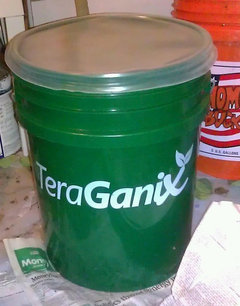
I have 3 of the 5 gallon buckets with air tight lids that are marketed by Teraganix. There is no internal screen or spigot attached at the base. I tend to put materials which do not generate much liquid.
Good to hear that news, robertz6.
Gerris2 (Joseph Delaware Zone 7a)
Original Author11 years agoTo answer your last question, I don't use a weight to press down the new additions. After I inoculate the material I manually press down on the new stuff to force out the air before putting on the air tight lid.
User
11 years agoI'd read on a bokashi forum about placing a plate on top of the new addition to the bucket and pushing down on the plate to apply pressure to compact everything. I found the plate fit really well into the 5 gallon buckets I used.
Shaul
11 years agoThe only problem with the 5-gal. buckets (at least the one's I have access to) is that they're wider at the top than at the bottom, so if you put in a plate and it's close to the diameter of the top of the bucket, then it's gonna get stuck somewhere on down. Also, as I add the waste and bran layers, I'm pushing it all down with the potato masher. When I get close to the top, I cover the food waste with a plastic bag and tuck it in on all sides. Then I put a flower pot base on top of it (I found that a 27 or 28 cm. diameter base is the right size) and weigh it down. For the first bucket I used a brick. For the second bucket I used a 2.5 kg. barbell weight which I wrapped in several layers of plastic sheet, because I've read that the fumes from the Bokashi process will interact with the steel (and the last thing you want is to have metal compounds leaching into your Bokashi which will then go into your garden &/or wormbin. For the third bucket, I bought a 5 kg. barbell weight. What I like about the barbell weights is that you get maximum weight in a flat round package that fits easily inside the bucket. This one I also wrapped in several layers of cellophane wrap. This week I spoke to the head of EM-Israel (the main distributor of EM products in Israel) and asked his opinion of using the heavier (5 kg) weight inside the bucket. He felt that using the heavier weight would not be a problem and so I am going ahead with that idea.
Shaul
robertz6
11 years agoI started out using 5 gallon buckets, and squarish kitty litter buckets. Now I use a smaller round buckets, say like something tile grout might come in. Shorter than a 5 gallon bucket and bit narrower also. I have three, used in rotation. Tried a pourer spout out of large detergent bottle, without success. The acid pH of the bokashi material ate the epoxy and caulks I tried to use to secure the spout to the bucket.
I put shredded paper at the bottom of the bucket. Every couple of days I pour out the excess leachate, since there is no drain spout to simplify matters. To seal the top and keep air out, I use two heavy plastic pieces (like a cut open chip bag such as Kettles), than a large black plastic bag, with a 10 pound flat weight on top to help add pressure. A large rubber band seals the plastic bag to the outside of the container to further reduce air movement.
Could not find any mention of vermi and bokashi together in "Worms Eat My Garbage", so the the OK mention of it must have been elsewhere.
Shaul
11 years agoHi Robert;
I had a similar experience with epoxy and caulk. I was trying to recreate a $50- Bokashi bucket (wherein all the liquid drains out and none is left at the bottom). After 3 days the epoxy (specifically for gluing plastics) and the silicon caulk (which was rated as waterproof and resistant to most chemicals) became useless. I guess they tested it on everything else except Bokashi juice.
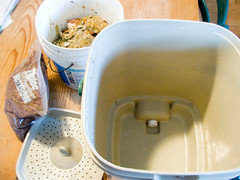
The picture I posted is the inside of a Bokashi bucket which can be purchased online (usually around $30 to $50). The strainer (at the left) sits on that lip around the inside. At one end is a small square indentation where the liquid flows out. The round, white, piece is obviously the plastic nut which secures the spigot in place. The small square space under it seems to be; that just in case you would need to change the spigot, there would be enough room to turn the nut and remove it (and then replace it again). In the end, the only liquid remaining in the bucket, at any one time, seems to be about: 1/4"-1/2" (D) X 1"-1.5" (square). That's not very much liquid at all.
Now, I have no problem installing a spigot at the very bottom of the 5 Gal buckets I use. The problem is that there needs to be room for the rubber washers and the nut to hold the spigot in place. In general, the bottom of the tube (where the liquid flows out through the spigot) is at least 1/2" off the floor. This means that the whole bottom of the bucket up to at least 1/2" is covered with liquid and then anything above that level is what flows out. This is far more than what there should be. One solution I've thought of (though I haven't yet been able to accomplish it) is to somehow raise the level of the floor to the level of the outlet tube. If anyone has any thoughts on this idea or any others, I'd appreciate it.Shaul
mendopete
11 years agoHi Shaul. I have been following your progress on this thread with a curious interest. Could you use an extra plastic bucket lid and cut it down to just the right size. Then drill holes for drainage. This false floor would be held up 1/2" by rocks or plastic PVC pipe cut and placed on the bottom. Good luck!
robertz6
11 years ago"Could not find any mention of vermi and bokashi together in "Worms Eat My Garbage", so the the OK mention of it must have been elsewhere."
Colleen Vanderlinden
at About.com
Organic GardeningAnswered this question about putting bokashi in worm bin with a 'YES'. Think her main qualification was a little at a time.
Gerris2 (Joseph Delaware Zone 7a)
Original Author11 years agoI had the good fortune to sit in on a composting class held by the soil scientist Dr. Elaine Ingham this past weekend. During a break, I asked her if it was possible to feed worms bokashi with success. She said it was possible after squeezing the liquid out of the bokashi you are introducing to the worm bin. She said adjusting the pH was not necessary, however, it was necessary to add a thin layer of bokashi to the bin surface.
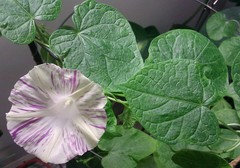
Here's a morning glory I've been growing indoors over the winter, which has benefited from worm poop tea on occasion.
pdavis991
10 years agoBeen reading all of your great posts and thought I would suggest checking out a guy named Bryan McGrath's videos on youtube. He talks a lot about bokashi composting, gives ways to make your own bokashi bran (even how to make your own EM like products), and even talks about using bokashi in worm bins in a couple of his videos.
Here is a link that might be useful: link to his youtube page
Gerris2 (Joseph Delaware Zone 7a)
Original Author10 years agoWow thank you for the link, I'm eager to watch the video!
hummersteve
10 years agoI wonder if I dont have a bit of a head start on this system. When I have enough veggie fruit scraps to run thru my juicer I save the pulp and store it in a closed container for at least a week when it becomes moldy and I feed bits of this to my worms . I could also add a bokashi mix to this if I wanted to go to the trouble though not sure I will. I do know that when I add this fermented mix to the bin the worms are on it in no time flat. Im just not sure of the benefit of adding bokashi to the mix and whether its worth the cost of the process.
woodennickel
9 years agoThis seems like a good idea for a Bokashi bucket
http://organicgardening.about.com/od/howtocompost/a/How-To-Make-An-Inexpensive-Bokashi-Bucket.htm
You have you false bottom, and no need for a spout.
Here is a link that might be useful: Bokashi bucket.
hummersteve
9 years agoIve heard and read a little about this process , sounds a bit expensive for the added innoculants. They also say meats can be in the mix.
I just wonder how close what some of us do are already considered Bokashi. I save all my scraps in ziplock bags and not just fruit and veggie either , Im not opposed to adding pancakes , old bread, have even added spaghetti to these zip bags.. Then when Ive saved enough all this mix goes thru my juicer and all the pulp is then saved in 2 gal canister with closed lid which is kept under the sink until worm feed is needed. So my question is how close is what I do to bokashi? Of course I dont add any meats, cheeses or oils at least not intentionally. Certainly my worm bins are doing fine and by breaking food down with what Im doing bacteria seems activate it rather quickly and thus usually the next day worms are on it if not sooner.
But I will say that the spaghetti is not broken down small enough as Id like and may or may not add it again depending how the worms deal with it.
chuckiebtoo
9 years agoThe easiest question any worm guru can answer is one asking about things you can feed worms. That's because if the material in question is organic, it can be fed to the vermi.
When someone wants to know if dryer lint or human hair is "worm-able", ask them if the dried clothing is 100% cotton, and if the "human" hair is 100% human.
Wish that could be said about some of the "food" products we stuff into our pieholes with ingredients unknown by people not chemists.
chuckiebtoo





Shaul